
Why Shirudo? Protecting Linux Systems Without Restarting
Critical Linux patches take time to test and deploy. During this window, your production servers remain vulnerable. Shirudo, developed by OpenAI and Cisco, fills this gap by blocking only the exploitation paths of vulnerabilities, without restarting the service or host (F1).
Validated Use Cases in Test Environments
- Java4Shell on Elasticsearch 9.5.5: A shield generated by Codex added input validation to the
java.util.Base64$Decoder.decode0method, blocking the exploit while keeping Elasticsearch online (F5). - Unnamed PHP Vulnerability: Discovered via OpenAI’s cyber model, a shield blocked exploitation attempts during a demonstration (F12).
These protections are temporary: they do not replace permanent patches but reduce the attack surface while patches are validated (F1).
Shirudo Architecture: Components and Workflow
Shirudo relies on three pillars:
- eBPF in the Kernel: An eBPF program loaded at boot acts as the control plane on each protected machine (F7).
- Java Bytecode: For JVM applications (e.g., Elasticsearch), Shirudo injects bytecode directly into running processes (F2).
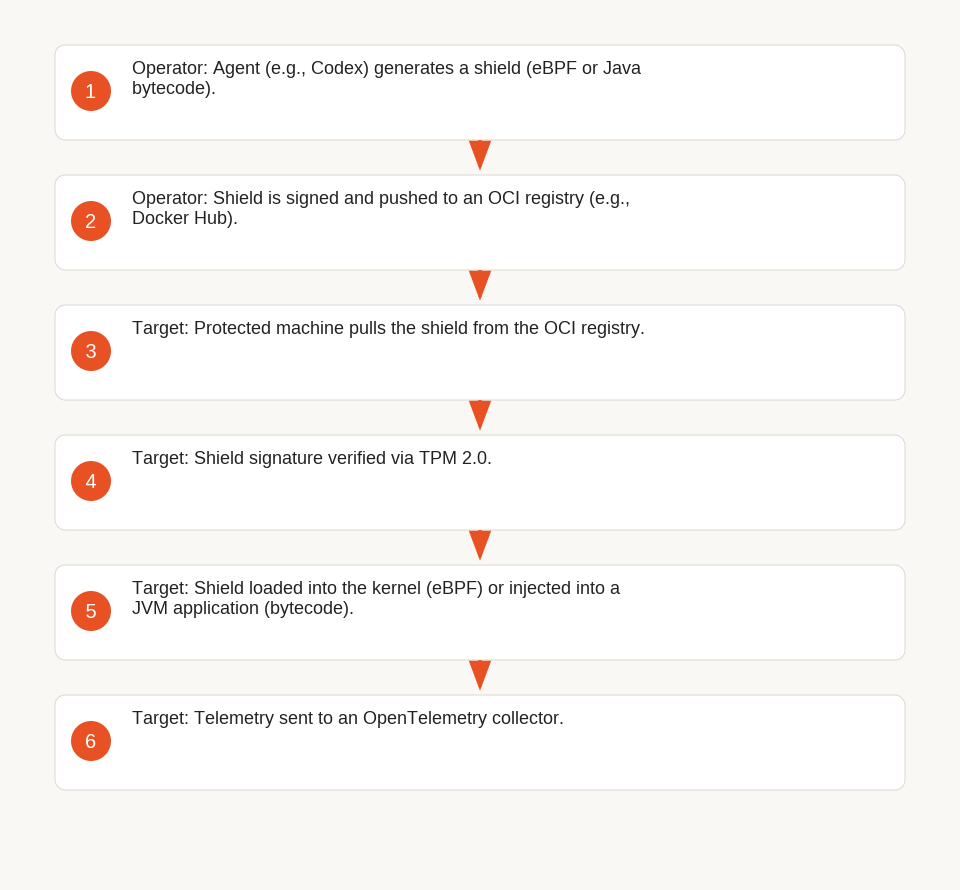
- Signed Shields (.bee): Protections are distributed via an OCI registry (like container images) and validated by the target’s TPM 2.0 before loading (F3).
Deployment Workflow
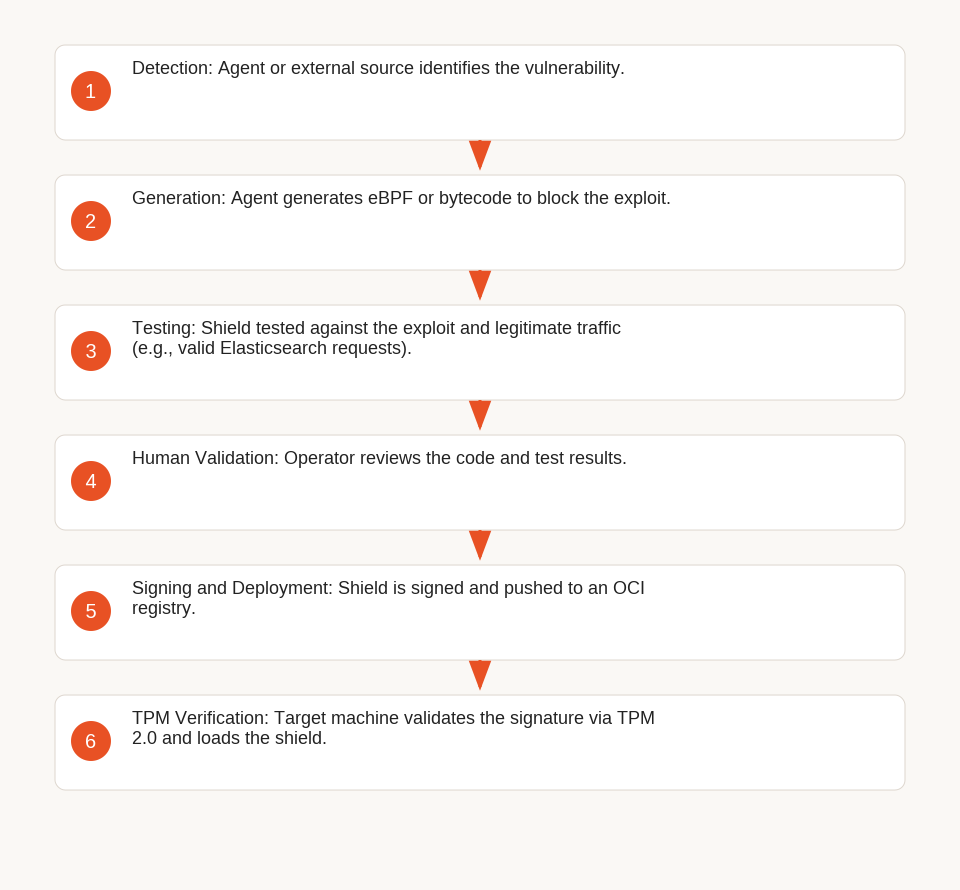
The process follows 6 steps (F4):
- Detection: An agent (e.g., Codex) or external source identifies the vulnerability.
- Shield Generation: The agent generates eBPF or bytecode to block the exploit, with a reproducer for validation.
- Testing: The shield is tested against the exploit and legitimate traffic (e.g., valid Elasticsearch requests).
- Human Validation: An operator reviews the code and test results.
- Signing and Deployment: The shield is signed and pushed to an OCI registry.
- TPM Verification: The target machine pulls the shield, validates its signature via TPM 2.0, and loads it (F3).
Changes are recorded in a TPM measurement chain, enabling later verification of applied protections (F10).
Example: Automating Shield Generation with n8n
To integrate Shirudo into your DevOps pipelines, use an n8n workflow:
- Step 1: A webhook receives a vulnerability alert (e.g., from GitHub Advisory Database).
- Step 2: An n8n node calls an agent (e.g., Codex) to generate the shield.
- Step 3: The shield is tested in a staging environment via a Python script.
- Step 4: If tests pass, the shield is signed and pushed to a private OCI registry.
- Step 5: Targets pull the shield and apply it after TPM verification.
This workflow reduces the time between vulnerability detection and mitigation while maintaining human control over critical steps. For DevOps automation examples, see our no-code automation hub.
Technical Prerequisites for Deploying Shirudo
Shirudo is in pre-release (November 2026) and requires specific components (F8):
Target Side (Protected Machines)
- Linux Kernel: Must include the signed-loader ABI and Shirudo patches. As of November 2026, no mainstream distribution includes them by default (F8).
- TPM 2.0: Required for verifying shield signatures (F3).
- Architecture: x86-64 validated, arm64 in testing, riscv64 pending (F8).
- Dependencies: One-shot CLI (no permanent daemon), tools to seal BPF keys in a kernel keyring (F11).
Operator Side (Your Infrastructure)
- OCI Registry: For distributing signed shields (e.g., Docker Hub, GitHub Container Registry).
- Generation Agent: Codex or another agent capable of producing eBPF/bytecode (F4).
- OpenTelemetry Collector: To receive telemetry from targets (F10).
Boot-Time Enforcement
On production targets, Shirudo initializes from the initrd to protect its runtime and state, even in case of root compromise (F9). eBPF guards are attached before critical services start, ensuring continuous protection.
Limitations and Risks of Shirudo (November 2026)
Shirudo is a promising solution, but its current limitations must be considered:
Coverage and Maturity
- Pre-Release: Kernel and TPM 2.0 prerequisites are not standardized (F8).
- Limited Validated Cases: Only two test cases are publicly documented (Java4Shell and an unnamed PHP flaw) (F12).
- No Metrics: No performance metrics, false-positive rates, or coverage data beyond the 2 publicly documented test cases are available (F12).
Critical Dependencies
- Signing and TPM: Compromise of the signing key or TPM could allow malicious code injection (F3).
- Human Operator: Shield validation remains manual, which may slow deployment during crises (F4).
- Compatibility: No guarantees for all Linux kernels, JVM applications, or containerized environments (F8).
Operational Risks
- False Negatives: A poorly generated shield might not block all exploit variants.
- False Positives: Overly strict input validation could break legitimate functionality (e.g., valid Elasticsearch requests).
- Complexity: The agentic workflow (code generation by agents) adds complexity compared to traditional security policies (F6).
As OpenAI and Cisco stated, "Shirudo is a first step toward infrastructure that can adapt to emerging threats while remaining reliable."
Next Steps: Deploying Shirudo in Your Infrastructure
To get started with Shirudo:
- Test in Staging: Use the test VM provided in the GitHub repository to validate prerequisites and workflow (F8).
- Integrate Shirudo into Your Pipelines: Automate shield generation and deployment with n8n or a similar tool. For automation examples, see our no-code automation hub.
- Monitor Updates: Shirudo is under active development. Follow the GitHub repository for new features and fixes.
Shirudo does not replace a robust patch management strategy but provides an additional layer of protection during vulnerability windows. For DevOps teams, it’s a tool to evaluate alongside existing solutions like WAFs or SELinux policies.