
Why Use MedChemBench?
Drug discovery relies on complex trade-offs: a compound may effectively target a biological pathway but suffer from poor absorption or rapid degradation. Medicinal chemists must design, test, and compare related molecules to identify the best candidates. MedChemBench (F1) evaluates whether AI models can assist in this process by:
- Interpreting molecular structures (including stereochemistry).
- Reasoning from experimental evidence to explain results.
- Ranking and selecting compounds based on given criteria.
- Predicting numerical or categorical properties (e.g., inhibition concentration).
Benchmark Structure: 4 Evaluated Components
MedChemBench includes 99 problems sourced from 117 papers and patents, covering 761 distinct molecular structures (F3). For each problem, models receive:
- The biological target (e.g., PRMT5, a protein studied in oncology).
- The researchers’ goals (e.g., blocking a protein while improving absorption).
- Previously tested compounds and their experimental results.
- Contextual data (e.g., cell permeability measurements).
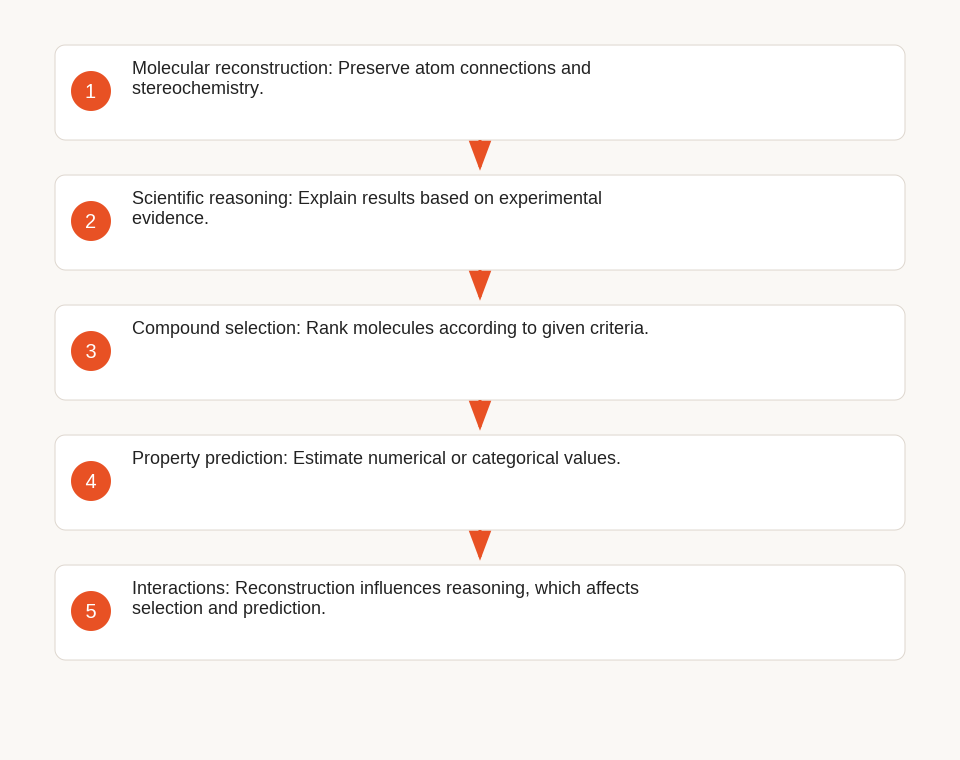
Performance is scored across 4 axes (F2):
- Molecular reconstruction: Preserving atom connections, rings, and stereochemistry (e.g., an 18-atom ring must be reconstructed without errors).
- Scientific reasoning: Explaining compound choices based on provided evidence (e.g., why compound 23 blocks PRMT5 better than compound 24).
- Compound selection: Ranking molecules according to specified criteria (e.g., prioritizing efficacy or stability).
- Property prediction: Estimating numerical values (e.g., inhibition concentration) or categorical properties (e.g., “high permeability”).
Concrete Example: PRMT5 Inhibitors
One MedChemBench problem (F7) focuses on three related compounds tested to inhibit PRMT5. The model must predict:
- The concentration required to inhibit PRMT5 in cells.
- Their ability to cross a cell barrier.
- Their degradation rate by liver enzymes in a lab assay.
Later experiments (withheld from the model) revealed a trade-off: compound 23 inhibited PRMT5 at a lower concentration, while compound 24 crossed the cell barrier more easily and degraded more slowly (F8). This example highlights the challenge of balancing multiple critical properties.
Model Performance: Strengths and Weaknesses
OpenAI evaluated 11 GPT models at varying reasoning-effort settings (F5, F12). Key findings:
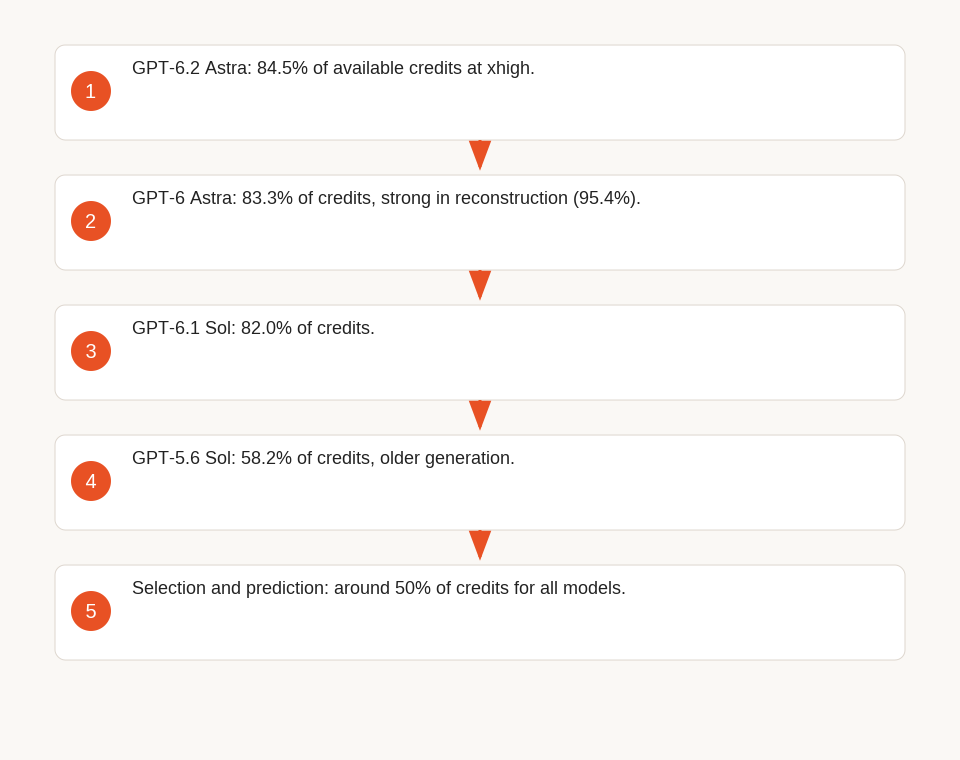
- At the xhigh setting, GPT-6.2 Astra scored 84.5% of available credits, ahead of GPT-6 Astra (83.3%) and GPT-6.1 Sol (82.0%).
- GPT-5.6 Sol, an older generation (released before GPT-6), reached only 58.2%.
- Performance gaps persist across components:
- Molecular reconstruction: GPT-6 Astra earned 95.4% of credits at xhigh (F11). In one problem, it correctly reconstructed a molecule with an 18-atom ring in 100% of attempts, while GPT-5.6 Sol and GPT-5.6 Luna failed every time (F10).
- Compound selection and property prediction: Models scored only about 50% of credits (F11), indicating significant room for improvement.
Common Errors
Models struggle particularly with:
- Stereochemistry: Some models alter the 3D structure of molecules, changing their identity (e.g., an 18-atom ring reduced to 15 atoms by GPT-5.6 Sol, F10).
- Multi-property trade-offs: Predicting efficacy, permeability, and stability simultaneously remains difficult (e.g., the PRMT5 example, F8).
- Reproducing provided measurements: Models must accurately restate experimental data already shared, which is not always the case.
Limitations of MedChemBench
While MedChemBench provides a rigorous evaluation, its results should be interpreted cautiously:
- No proof of new drug discovery or improved laboratory decisions: The benchmark measures reasoning abilities on published historical data, not real-world impact (F6).
- Static data: Models lack access to external tools, real-time feedback, or new experiments during evaluation (F4).
- Potential prior exposure: Problems are sourced from existing publications, and models may have encountered this data during training (F3).
- Narrow scope: MedChemBench focuses on medicinal chemistry reasoning, excluding other drug development stages (e.g., toxicology, clinical trials).
How to Leverage MedChemBench in Practice
1. Model Audit for R&D Projects
Considering an AI model to assist your chemists? MedChemBench helps you:
- Compare multiple models on tasks similar to your needs.
- Identify each model’s strengths and weaknesses (e.g., GPT-6 Astra excels in molecular reconstruction but struggles with property prediction, F6).
- Choose the best model for your use case (e.g., prioritizing reconstruction or compound selection).
2. Performance Tracking Over Time
AI models evolve rapidly. MedChemBench enables you to:
- Regularly evaluate new model versions (e.g., GPT-6.2 Astra vs. GPT-6 Astra, F5).
- Detect regressions or improvements on specific tasks.
- Adapt your workflows based on results (e.g., switch models if a new version scores better in property prediction).
3. Model Training and Improvement
MedChemBench can serve as a foundation for:
- Training models on medicinal chemistry tasks (e.g., fine-tuning on benchmark problems).
- Identifying gaps to address (e.g., improving stereochemistry or property prediction).
- Creating synthetic datasets for specific tasks (e.g., generating molecules with target properties).
Recommendations to Maximize MedChemBench’s Utility
- Complement with other benchmarks: MedChemBench focuses on medicinal chemistry reasoning. For a broader evaluation, combine it with other tools (e.g., ADMET property prediction benchmarks, in silico toxicology tests).
- Tailor problems to your domain: If your projects target a specific protein family (e.g., kinases), select or create relevant MedChemBench problems for those targets.
- Document limitations: MedChemBench doesn’t cover all aspects of drug discovery. Supplement it with lab evaluations or internal data tests.
- Collaborate with chemists: Involve your medicinal chemistry experts to interpret results and identify the most relevant use cases for your organization.
How to Integrate MedChemBench into Your Processes
To use MedChemBench systematically, here’s a hypothetical approach you could implement:
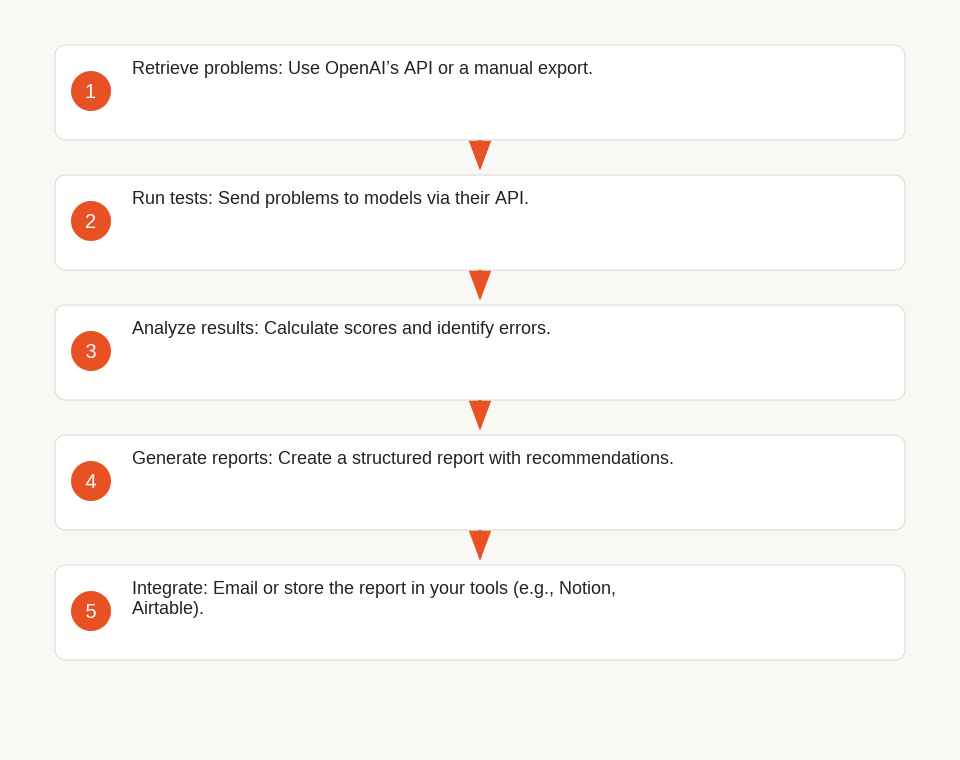
- Retrieve MedChemBench Problems: Use OpenAI’s API or a manual export to obtain the 99 problems in JSON format. Each problem includes:
- The context (biological target, goals, tested compounds).
- Experimental data provided to the model.
- Expected answers (for scoring).
- Test Your Models: For each model to evaluate:
- Send the problem via the model’s API (e.g., OpenAI, Anthropic).
- Retrieve the response and compare it to expected answers.
- Calculate scores for each component (reconstruction, reasoning, etc.).
- Analyze Results:
- Aggregate scores by model and component.
- Identify recurring errors (e.g., incorrect stereochemistry).
- Generate visualizations (e.g., comparative performance charts).
- Generate a Report:
- Create a structured report with:
- A summary of overall performance.
- A detailed analysis by component.
- Examples of errors and correct answers.
- Recommendations for improving results (e.g., adjusting reasoning parameters).
- Export the report in the desired format (Markdown, HTML, PDF).
- Create a structured report with:
- Integrate Results into Your Tools:
- Email the report to your team.
- Store it in a tool like Notion or Airtable for regular tracking.
Conclusion
MedChemBench provides a standardized method for evaluating AI models’ reasoning abilities in medicinal chemistry. By using it, you can:
- Objectively compare multiple models on critical tasks.
- Identify each model’s strengths and weaknesses.
- Generate insights to guide your R&D decisions.
However, keep its limitations in mind: it doesn’t prove the ability to discover new drugs and relies on published historical data. For a comprehensive evaluation, combine it with other tools and lab testing.
To learn more, discover how to deploy custom AI solutions for your R&D.