Understanding Enterprise RAG Architecture in 2026
A Retrieval-Augmented Generation (RAG) system represents a fundamental shift in how enterprises leverage large language models (LLMs). Instead of relying solely on pre-trained knowledge, RAG systems query your organization's knowledge base in real-time, combining the generative capabilities of LLMs with precise, up-to-date information from your documents, databases, and proprietary sources.
According to MarketsandMarkets, the RAG market is projected to reach USD 9.86 billion by 2030, growing at a 38.4% CAGR from USD 1.94 billion in 2025. Yet despite this explosive growth, NStarX Inc. reports that 40–60% of RAG implementations fail to reach production due to retrieval quality issues and governance gaps.
The Three Pillars of Production-Ready RAG
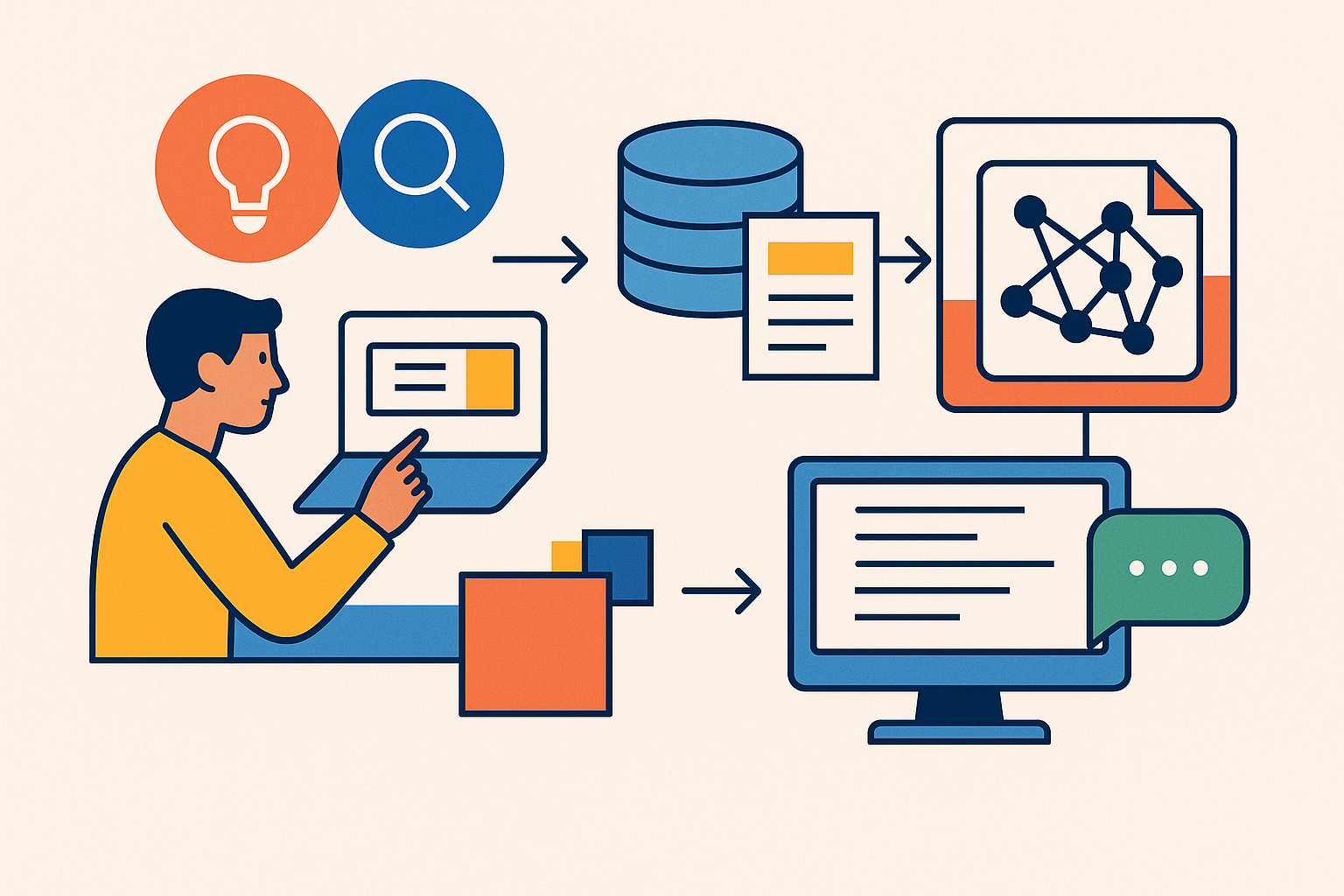
A robust enterprise RAG system consists of three interconnected components:
- Indexing Pipeline: Transforms documents (PDFs, databases, wikis) into semantic vectors stored in a vector database like Pinecone, Weaviate, or Qdrant
- Retrieval Engine: Searches for the most relevant passages using hybrid approaches (dense + sparse retrieval) and reranking techniques
- Augmented Generator: An LLM (GPT-4, Claude, Mistral) that synthesizes responses grounded in retrieved documents
Organizations implementing RAG report 65-85% higher user trust in AI-generated outputs compared to standalone LLMs, according to Makebot.ai research from 2025.
"RAG isn't just a technical enhancement—it's a paradigm shift that transforms LLMs from impressive but unreliable assistants into trustworthy knowledge workers grounded in organizational reality." — NStarX Inc. 2026 Report
Technology Stack Selection
For enterprise implementations in 2026, here's a battle-tested stack:
| Component | Recommended Solution | Rationale |
|---|---|---|
| Vector Database | Qdrant, Weaviate, or Pinecone | Scalability, hybrid search support, enterprise features |
| Embedding Model | text-embedding-3-large or multilingual-e5-large | High performance, multilingual support, cost-effective |
| LLM | GPT-4o, Claude 3.5 Sonnet, or Llama 3.1 | Quality/cost balance, function calling, long context |
| Orchestration | LangChain or LlamaIndex | Mature ecosystem, extensive integrations, active community |
| Evaluation | RAGAS, TruLens, or Galileo | Systematic quality assessment, production monitoring |
At Keerok, we help international clients architect and deploy production-grade RAG systems. Explore our RAG and knowledge management expertise to learn how we can accelerate your implementation.
Step 1: Data Preparation and Intelligent Indexing
The quality of your RAG system is fundamentally constrained by your data preparation. This is the most time-intensive phase but also the most critical for success.
Knowledge Source Audit and Cleanup
Begin by identifying and evaluating your knowledge sources:
- Technical documentation and standard operating procedures
- Support ticket history and email archives
- Existing knowledge bases (Confluence, Notion, SharePoint)
- Contracts, reports, and regulatory documents
- Code repositories and API documentation
A financial services case study demonstrates the impact: a well-implemented RAG system achieved an 85% reduction in regulatory research time with 93% accuracy, resulting in $4.2M in annual savings and a 67% decrease in compliance errors.
Intelligent Chunking: Preserving Semantic Context
Document chunking is both art and science. In 2026, adaptive chunking strategies have become standard:
# Adaptive chunking with LangChain
from langchain.text_splitter import RecursiveCharacterTextSplitter

text_splitter = RecursiveCharacterTextSplitter(
    chunk_size=1000,  # Optimal for most use cases
    chunk_overlap=200,  # Preserve context across boundaries
    separators=["\n\n", "\n", ". ", " ", ""],
    length_function=len
)

chunks = text_splitter.split_documents(documents)
For complex technical documents, implement semantic chunking that respects logical structure (sections, thematic paragraphs) rather than mechanical character-count splitting. Advanced approaches include:
- Hierarchical chunking: Maintain parent-child relationships between document sections
- Sliding window with metadata: Include surrounding context as metadata
- Proposition-based chunking: Split on complete ideas/claims rather than arbitrary boundaries
Embedding Generation and Vector Storage
Once chunks are prepared, transform them into vector representations:
# Embedding generation with OpenAI and Qdrant storage
import openai
from qdrant_client import QdrantClient
from qdrant_client.models import Distance, VectorParams, PointStruct

client = QdrantClient(url="http://localhost:6333")

# Create collection
client.create_collection(
    collection_name="enterprise_knowledge",
    vectors_config=VectorParams(size=3072, distance=Distance.COSINE)
)

# Index documents with metadata
for i, chunk in enumerate(chunks):
    embedding = openai.embeddings.create(
        model="text-embedding-3-large",
        input=chunk.page_content
    ).data[0].embedding

    client.upsert(
        collection_name="enterprise_knowledge",
        points=[PointStruct(
            id=i,
            vector=embedding,
            payload={
                "text": chunk.page_content,
                "source": chunk.metadata.get("source"),
                "department": chunk.metadata.get("department"),
                "last_updated": chunk.metadata.get("date")
            }
        )]
    )
For organizations with data sovereignty requirements, consider self-hosted embedding models like multilingual-e5-large or the Mistral embedding suite, which can be deployed entirely within your infrastructure.
Step 2: Building an Intelligent Retrieval Pipeline
Retrieval is the heart of your RAG system. In 2026, hybrid approaches combining dense (vector) and sparse (keyword) retrieval dominate production systems.
Hybrid Search: Best of Both Worlds
According to 2026 trends identified by NStarX Inc., 60% of new RAG deployments include systematic evaluation from day one, up from less than 30% in 2025. This rigor begins with robust retrieval strategies.
# Hybrid retrieval implementation
from langchain.retrievers import EnsembleRetriever
from langchain.vectorstores import Qdrant
from langchain.retrievers import BM25Retriever

# Vector retriever
vector_store = Qdrant(client=client, collection_name="enterprise_knowledge")
vector_retriever = vector_store.as_retriever(
    search_type="mmr",  # Maximum Marginal Relevance for diversity
    search_kwargs={"k": 10, "fetch_k": 50}
)

# BM25 keyword retriever
bm25_retriever = BM25Retriever.from_documents(documents)
bm25_retriever.k = 10

# Ensemble with weighted combination
ensemble_retriever = EnsembleRetriever(
    retrievers=[vector_retriever, bm25_retriever],
    weights=[0.6, 0.4]  # Favor vector search slightly
)
Hybrid search addresses the weaknesses of each approach: vector search handles semantic similarity but struggles with exact matches and rare terms, while BM25 excels at exact matches but misses semantic relationships.
Reranking: Precision Refinement
After initial retrieval, a reranking model (Cohere Rerank, BGE-reranker, or cross-encoders) reorders results to maximize relevance:
- 15-25% improvement in top-3 precision on average
- Reduces noise in generated responses
- Marginal cost compared to quality gains
- Enables metadata-aware ranking (recency, authority, department relevance)
"Reranking is no longer optional in 2026—it's a standard component of production RAG systems that separates acceptable responses from exceptional ones." — Galileo.ai Technical Guide
Query Transformation Techniques
Advanced RAG systems transform user queries before retrieval:
- Query expansion: Generate related queries to capture different phrasings
- Hypothetical document embeddings (HyDE): Generate a hypothetical answer, embed it, and use that for retrieval
- Step-back prompting: Extract higher-level concepts before retrieving specifics
These techniques are particularly valuable in healthcare contexts, where a case study showed 72% faster access to clinical information and 91% improved clinician confidence in treatment decisions.
Step 3: Orchestrating Augmented Generation
Once relevant documents are retrieved, the LLM must synthesize them intelligently while respecting enterprise constraints around accuracy, citations, and compliance.
Prompt Engineering for Enterprise RAG
The prompt is your control interface. Here's a production-tested template:
SYSTEM_PROMPT = """You are an AI assistant for [COMPANY_NAME].
Your role is to answer questions based ONLY on the provided documents.

Strict rules:
1. Always cite your sources (document name, section)
2. If information isn't in the documents, say "I don't have this information in the knowledge base"
3. Remain factual and professional
4. Provide step-by-step reasoning for complex questions
5. Highlight any contradictions between sources

Reference documents:
{context}

Question: {question}

Detailed answer with citations:"""
Hallucination Prevention and Response Validation
Hallucinations remain a critical challenge. Implement these guardrails:
- Mandatory citations: Force the LLM to cite sources for each claim
- Confidence scoring: Evaluate similarity between response and source chunks
- Human-in-the-loop: For critical domains (legal, medical), integrate validation workflows
- Comprehensive logging: Trace every query, retrieved chunks, and generated response
- Contradiction detection: Flag when retrieved documents contain conflicting information
Complete Pipeline with LangChain
from langchain.chains import RetrievalQA
from langchain.chat_models import ChatOpenAI
from langchain.prompts import PromptTemplate
from langchain.callbacks import get_openai_callback

# LLM configuration
llm = ChatOpenAI(
    model="gpt-4o",
    temperature=0.1,  # Low temperature for factual responses
    max_tokens=1000
)

# Prompt template
prompt_template = PromptTemplate(
    input_variables=["context", "question"],
    template=SYSTEM_PROMPT
)

# Complete RAG chain
qa_chain = RetrievalQA.from_chain_type(
    llm=llm,
    chain_type="stuff",  # or "map_reduce" for long contexts
    retriever=ensemble_retriever,
    return_source_documents=True,
    chain_type_kwargs={"prompt": prompt_template}
)

# Usage with cost tracking
with get_openai_callback() as cb:
    result = qa_chain({"query": "What is our refund policy for enterprise customers?"})
    print(f"Response: {result['result']}")
    print(f"\nSources: {[doc.metadata for doc in result['source_documents']]}")
    print(f"\nCost: ${cb.total_cost:.4f}")
Step 4: Production Deployment and Monitoring
Production deployment is where 40-60% of RAG projects fail. Here's how to de-risk your rollout.
Recommended Deployment Architecture
Adopt a phased deployment approach:
- Pilot phase (2-4 weeks): Limited deployment to test department, intensive feedback collection
- Scaling phase (1-2 months): Progressive rollout with reinforced monitoring
- General production: Full deployment with defined SLAs
According to 2026 trends, shared knowledge runtimes now enable 4–8 week deployment timelines, 3–4× faster than 2025, by providing pre-built infrastructure and governance frameworks.
Essential Monitoring Metrics
Track these KPIs continuously:
| Metric | Target | Action on Deviation |
|---|---|---|
| Average latency | < 3 seconds | Optimize retrieval or scale infrastructure |
| User satisfaction rate | > 80% | Analyze negative feedback, adjust prompts |
| Citation accuracy | > 95% | Review chunking and reranking |
| "Don't know" rate | 10-15% | Enrich knowledge base if > 20% |
| Hallucination rate | < 5% | Strengthen validation, adjust temperature |
| Cost per query | Budget-dependent | Optimize model selection, caching strategy |
Observability and Debugging
Implement comprehensive observability:
# Example with LangSmith tracing
import os
from langchain.callbacks.tracers import LangChainTracer

os.environ["LANGCHAIN_TRACING_V2"] = "true"
os.environ["LANGCHAIN_API_KEY"] = "your-api-key"

tracer = LangChainTracer(project_name="enterprise-rag-prod")

result = qa_chain(
    {"query": query},
    callbacks=[tracer]
)
This enables you to debug issues by inspecting the full execution trace: query transformation, retrieval results, prompt construction, and LLM response.
Security and Compliance
Enterprise RAG systems must address:
- Encryption: At rest (AES-256) and in transit (TLS 1.3)
- Access control: Role-based permissions, document-level security
- Audit logging: Complete query history with user attribution
- Data residency: Ensure compliance with GDPR, HIPAA, or industry-specific regulations
- PII handling: Automated detection and redaction of sensitive information
At Keerok, we help international organizations navigate these compliance requirements. Get in touch with our team for a security assessment of your RAG implementation.
Continuous Evaluation and System Improvement
A RAG system is never "finished." Continuous evaluation distinguishes successful implementations from failures.
The RAGAS Evaluation Framework
RAGAS (Retrieval-Augmented Generation Assessment) has become the 2026 standard, evaluating four dimensions:
- Faithfulness: Is the response grounded in source documents?
- Answer relevancy: Does the response precisely address the question?
- Context precision: Are retrieved chunks relevant?
- Context recall: Were all relevant chunks retrieved?
from ragas import evaluate
from ragas.metrics import (
    faithfulness,
    answer_relevancy,
    context_precision,
    context_recall
)
from datasets import Dataset

# Test dataset
test_data = {
    "question": ["What is the warranty period?"],
    "answer": [result["result"]],
    "contexts": [[doc.page_content for doc in result["source_documents"]]],
    "ground_truth": ["2 years for all products"]
}

dataset = Dataset.from_dict(test_data)

# Evaluation
scores = evaluate(
    dataset=dataset,
    metrics=[faithfulness, answer_relevancy, context_precision, context_recall]
)
print(scores.to_pandas())
Continuous Improvement Loop
Establish an iterative process:
- Weekly collection of poorly-answered queries (score < 3/5)
- Monthly analysis of failure patterns and root causes
- Quarterly enrichment of knowledge base based on gap analysis
- A/B testing of prompt modifications and retrieval strategies
- Model updates: Track and evaluate new LLM releases
"Organizations that succeed with RAG treat evaluation not as a final step, but as a continuous process woven into the system's DNA." — AICerts.ai 2025 Report
Advanced Optimization Techniques
As your system matures, implement advanced optimizations:
- Query routing: Direct different query types to specialized retrievers or LLMs
- Caching: Cache embeddings and common responses to reduce latency and cost
- Multi-agent systems: Deploy specialized agents for different knowledge domains (40% of enterprise AI by 2027)
- Feedback loops: Use user feedback (thumbs up/down, corrections) to fine-tune retrievers
- Knowledge graph integration: Combine vector search with structured knowledge for complex reasoning
Conclusion: Your RAG Implementation Roadmap
Building an enterprise RAG system in 2026 is simultaneously more accessible and more demanding than ever. The tools have matured, frameworks are robust, but expectations for quality and compliance are high.
Your concrete next steps:
- Audit current knowledge sources and identify a high-impact pilot use case with measurable success metrics
- Select your technology stack based on constraints (data sovereignty, budget, team skills, scalability needs)
- Build an MVP in 4-6 weeks: Index a limited source, implement basic retrieval, establish systematic evaluation
- Iterate based on real user feedback, not assumptions—deploy quickly and learn fast
- Plan governance and maintenance from day one: knowledge base updates, model monitoring, security reviews
With a market projected to reach USD 9.86 billion by 2030 and multi-agent RAG systems deployed in 40% of enterprise AI applications by 2027, the time to act is now. Early movers who implement robust RAG systems will gain significant competitive advantages in knowledge work efficiency and decision quality.
Need expert guidance for your RAG implementation? Keerok specializes in RAG systems and enterprise knowledge management. We help international organizations architect, deploy, and optimize production-grade RAG systems—from initial audit through full-scale deployment. Schedule a consultation with our team to discuss your specific use case and accelerate your time-to-value.