Understanding Enterprise RAG: Architecture and Core Concepts
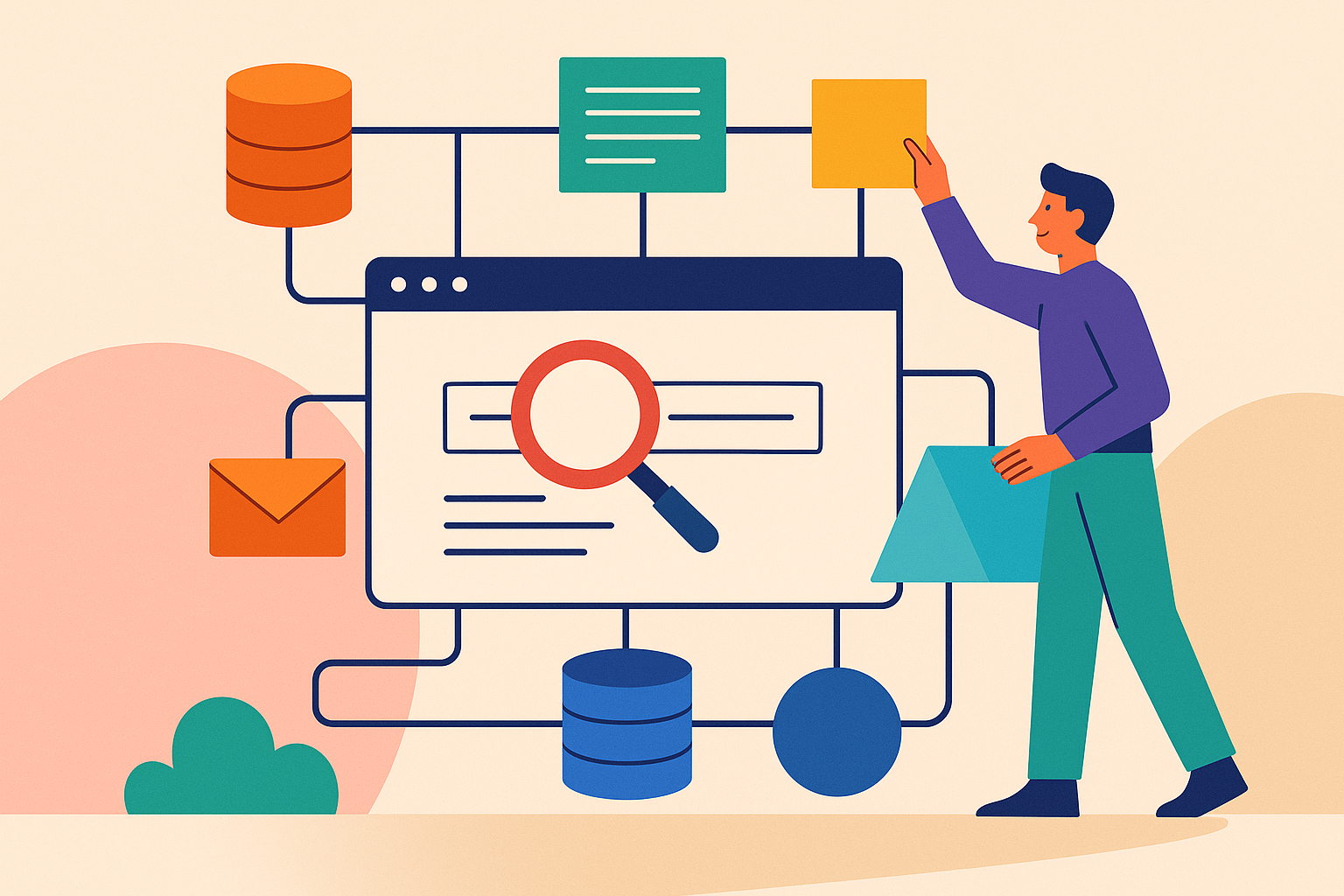
Retrieval-Augmented Generation (RAG) has evolved from an academic concept to a production-critical technology for enterprise knowledge management. Unlike traditional language models that rely solely on training data, RAG systems query your proprietary knowledge base before generating responses, ensuring accuracy, context-awareness, and verifiability.
According to entreprises.gouv.fr, RAG systems can provide employees with pre-drafted emails and meeting summaries, generating significant time and productivity gains. The architecture combines three fundamental components that work in concert to deliver this value.
The RAG Pipeline: From Query to Response
A production RAG system follows this workflow:
- Query Processing: User question is analyzed, potentially reformulated, and converted to embeddings
- Retrieval: Vector search identifies the most relevant documents/chunks from your knowledge base
- Context Augmentation: Retrieved content is formatted and injected into the LLM prompt
- Generation: LLM produces a response grounded in the retrieved context
- Post-Processing: Citations are added, hallucinations are detected, and quality checks are performed
Each stage presents optimization opportunities that can improve accuracy by 30-50% compared to naive implementations.
Why RAG Outperforms Fine-Tuning for Most Enterprise Use Cases
The RAG vs fine-tuning debate is central to any enterprise AI strategy. Here's the definitive breakdown:
| Criterion | RAG | Fine-Tuning |
|---|---|---|
| Data Freshness | Real-time updates, no retraining | Requires complete retraining for updates |
| Traceability | Every answer cites source documents | Black box, no source attribution |
| Cost | $2K-$10K initial setup + API costs | $10K-$50K per training cycle |
| Data Privacy | Full control, on-premise possible | Must share data with training provider |
| Domain Adaptation | Instant with new documents | Weeks of retraining required |
According to Nexa Automatia, hybrid approaches are gaining traction in 2026: a fine-tuned model for style and tone, paired with RAG for factual knowledge. This architecture delivers the best of both worlds—consistent voice with up-to-date information.
"RAG is not just a technical solution—it's a fundamental shift in how enterprises access and leverage their institutional memory."
Building Your RAG Architecture: Technical Deep Dive
Constructing a robust enterprise RAG system requires careful architectural decisions across four critical layers. Each component must be sized for your data volumes, latency requirements, and accuracy targets.
Layer 1: Data Ingestion and Preprocessing
RAG quality is directly proportional to ingestion quality. Enterprise data sources typically include:
- Structured Documents: PDF, DOCX, XLSX with OCR for scanned content
- Databases: PostgreSQL, MySQL, MongoDB via SQL/NoSQL connectors
- Business Systems: CRM (Salesforce, HubSpot), ERP (SAP, NetSuite), DMS (SharePoint, Google Drive)
- Web Sources: Internal wikis, Confluence, Notion, custom portals
The most critical preprocessing step is chunking—splitting documents into semantically coherent segments. According to Loris Gautier, semantic chunking outperforms fixed-size chunking by preserving paragraph integrity and conceptual boundaries, improving retrieval relevance by 30-40%.
Semantic chunking strategies include:
- Sentence-window chunking: Retrieve sentences but provide surrounding context for generation
- Recursive splitting: Split by paragraphs, then sentences, then tokens if necessary
- Document structure preservation: Maintain headings, lists, and tables as metadata
- Overlap strategy: 10-20% overlap between chunks to avoid context loss at boundaries
Layer 2: Embeddings and Vector Storage
Embeddings transform text into mathematical representations that enable semantic search. In 2026, three approaches dominate:
- OpenAI text-embedding-3-large: 3,072 dimensions, excellent multilingual support, $0.13/million tokens
- Open-source models: multilingual-e5-large, sentence-transformers—free but require GPU infrastructure
- Specialized embeddings: Cohere Embed v3 for multilingual, Voyage AI for code, Jina AI for long context
Vector database selection depends on your scale and infrastructure preferences:
| Database | Best For | Key Features |
|---|---|---|
| Pinecone | Managed, zero-ops | Auto-scaling, <50ms latency, serverless |
| Weaviate | Open-source, hybrid search | Native filtering, multi-tenancy, GraphQL |
| Qdrant | High performance | Rust-based, advanced filtering, 10M+ vectors |
| Chroma | Development, prototyping | Embedded mode, simple API, fast iteration |
| PostgreSQL + pgvector | Existing SQL infrastructure | No new stack, familiar queries, ACID guarantees |
Layer 3: Advanced Retrieval Strategies
Basic cosine similarity search hits limitations quickly. Production RAG systems in 2026 implement these advanced techniques:
- Hybrid Search: Combines vector search (semantic) with BM25 (keyword) using weighted fusion. Average relevance improvement: +25%. Particularly effective for acronyms, product codes, and proper nouns that embeddings struggle with.
- Re-ranking: A specialized model (Cohere Rerank, Cross-Encoder) re-scores initial results using the actual query. Reduces false positives by 40% with minimal latency impact (30-50ms).
- Multi-query Retrieval: Generates 3-5 query reformulations to capture different user intents. Increases recall by 30%, critical for complex or ambiguous questions.
- HyDE (Hypothetical Document Embeddings): Generates a hypothetical answer, embeds it, and searches for similar documents. Exceptionally effective for complex analytical questions where the query itself lacks semantic richness.
- Parent-Child Chunking: Retrieve small chunks for precision, but provide larger parent chunks for generation context. Balances relevance with completeness.
According to Thiga, integrating these techniques into a LangGraph pipeline enables precision rates exceeding 85% on knowledge bases with 50,000+ documents.
Layer 4: Generation and Quality Assurance
The generation phase orchestrates the LLM with retrieved context. Multi-model architectures have become standard:
- Reasoning models (GPT-4, Claude 3.5 Sonnet, GPT-5 preview): Complex questions requiring deep analysis
- Efficient models (Gemini Flash, GPT-4o-mini): Simple queries, FAQ, draft generation
- Intelligent routing: Classify query complexity to select optimal model (60% cost reduction on API calls)
Quality assurance mechanisms include:
- Source citation: Every claim links to source document with page numbers and confidence scores
- Hallucination detection: Verify response consistency with retrieved context using entailment models
- Content filtering: Automated moderation to prevent inappropriate responses
- Confidence scoring: Explicit "I don't know" when retrieved context is insufficient (better than hallucinated answers)
For a comprehensive implementation guide, explore our enterprise RAG expertise covering architecture patterns, technology selection, and deployment strategies.
"A production RAG system isn't measured by its technical sophistication, but by its ability to reduce information retrieval time by 80% while guaranteeing full traceability."
Implementation Roadmap: From POC to Production
Transitioning from a RAG prototype to a production-grade system follows a proven four-phase methodology. According to Nocodefactory.fr, critical stages like data collection take 2-3 days of setup plus ongoing maintenance, underscoring the time investment for enterprise RAG.
Phase 1: POC and Validation (2-3 weeks)
Objective: Validate technical feasibility and business value with a constrained scope.
- Corpus Selection: 100-200 representative documents from your knowledge base
- Minimal Stack: LangChain + OpenAI + Pinecone (or equivalent) for rapid iteration
- Core Metrics: Response accuracy (manual evaluation on 50 questions), latency, cost per query
- User Feedback: 5-10 early adopters testing in real conditions
POC Budget: $2K-$4K (infrastructure + API + consulting)
Phase 2: MVP and Integration (1-2 months)
Expand scope and integrate into existing workflows:
- Full Corpus: Ingest 1,000-10,000 documents depending on your volume
- Ingestion Pipelines: Automate updates (daily, weekly) with change detection
- User Interface: Slack/Teams chatbot, internal web portal, or API integration into your applications
- Access Control: Filter results based on user permissions (critical for HR, financial data)
For enterprises prioritizing no-code approaches, n8n has emerged as the reference solution. According to Loris Gautier, n8n enables building visual, self-hosted RAG workflows integrating semantic chunking, embeddings, vector storage, and generation without writing code.
Key n8n advantages for enterprise RAG:
- Visual workflow builder: Drag-and-drop nodes for each pipeline stage
- Self-hosted: Full data control, GDPR compliance, no vendor lock-in
- Pre-built connectors: Google Drive, Notion, Airtable, SharePoint, PostgreSQL, and 400+ integrations
- Custom code nodes: JavaScript/Python for specialized logic when needed
Phase 3: Optimization and Scaling (2-3 months)
Continuous improvement based on real usage data:
- A/B Testing: Compare chunking strategies, embeddings, retrieval approaches
- Retrieval Fine-Tuning: Adjust similarity thresholds, hybrid search weights, re-ranking parameters
- Advanced Monitoring: P95 latency, "I don't know" rate, user feedback (thumbs up/down)
- Infrastructure Scaling: Distributed vector databases, embedding caching, CDN for documents
Phase 4: Production and Governance (Ongoing)
Maintain quality and evolve the system:
- Data Updates: Automated pipelines with obsolete document detection
- Continuous Evaluation: Automatically generate test questions, compare with reference answers (RAGAS, Trulens)
- Version Management: Rollback capability in case of performance degradation
- Compliance: GDPR right to be forgotten, data lineage tracking, encryption at rest and in transit
Case study: A mid-sized manufacturing company implemented RAG for technical documentation access. Results after 3 months:
- New employee onboarding time reduced from 6 weeks to 3 weeks
- Support ticket resolution time decreased by 45%
- 95% user satisfaction rate (vs. 60% with previous search system)
- ROI positive after month 3 due to productivity gains
Get in touch with our team for a personalized feasibility audit of your enterprise RAG project.
Common Pitfalls and Best Practices in 2026
After deploying dozens of enterprise RAG systems, we've identified recurring pitfalls and winning practices.
Critical Mistakes to Avoid
- Uniform Chunking Without Context: Splitting all documents into 512-token blocks destroys coherence. Use semantic chunking with heading and structure preservation.
- Neglecting Metadata Quality: Filters (date, department, document type) improve relevance by 40%. Systematically enrich your chunks with structured metadata.
- Underestimating API Costs: A poorly optimized RAG can cost $500+/month in embeddings and generation. Implement caching and batching from day one.
- Ignoring User Feedback: Thumbs up/down are your best improvement signal. Create a feedback loop starting with the MVP.
- Generic Prompts: "Answer the question" isn't enough. Specify format, detail level, citation requirements, and constraints explicitly.
- No Fallback Strategy: When retrieval fails, provide actionable alternatives (suggest related topics, escalate to human expert).
Proven Best Practices
- Start Small, Iterate Fast: RAG on 200 well-chosen documents beats a system on 10,000 poorly prepared documents.
- Blind Testing: Compare RAG answers vs. manual search on 100 real questions. Target 80%+ satisfaction before scaling.
- Document Limitations: Clearly communicate what the system can and cannot do. Transparency builds trust.
- Involve Business Experts: Domain experts must validate response relevance, not just IT.
- Automate Evaluation: Generate 500+ question/answer reference pairs, automatically evaluate each deployment.
- Implement Observability: Log every query, retrieval result, and generation for debugging and continuous improvement.
"RAG project success depends less on architectural sophistication than on data preparation rigor and continuous end-user engagement."
Emerging Trends: The Future of Enterprise RAG
The RAG landscape is evolving rapidly. Here are the structural trends shaping enterprise implementations in 2026.
Agentic RAG Systems
According to Polara Studio, AI agents capable of reasoning, planning, and acting autonomously are transforming RAG in 2026. These agents:
- Decompose Complex Questions: "What's the average ROI of our 2025 marketing campaigns by channel?" becomes 3-4 targeted sub-queries
- Orchestrate Multiple Sources: Combine CRM, analytics, internal documents in a single response flow
- Learn from Failures: Remember queries without satisfactory answers, suggest knowledge base improvements
- Execute Actions: Beyond answering questions, agents can create tickets, update records, trigger workflows
Frameworks like LangGraph and AutoGen facilitate building these agents with state management, persistent memory, and custom tools.
Multimodal RAG
Integration of images, technical diagrams, and videos into RAG systems is becoming standard:
- Vision Embeddings: CLIP, OpenAI Vision enable search across diagrams, product photos, screenshots
- Advanced Text Extraction: Enhanced OCR for handwritten documents, complex tables, mathematical formulas
- Multimodal Generation: Responses combining text, generated charts, relevant video excerpts
Use cases include:
- Technical support with visual troubleshooting guides
- Product catalogs with image-based search
- Training materials combining documentation and video tutorials
Local RAG and Data Sovereignty
Enterprises in regulated sectors (healthcare, finance, defense) increasingly prioritize self-hosted solutions:
- Open-Source Models: Mistral AI, Llama 3, Gemma deployed on private infrastructure
- Local Embeddings: multilingual-e5-large, sentence-transformers without external API calls
- On-Premise Vector Databases: Weaviate, Qdrant, Milvus hosted in company datacenters
This approach guarantees GDPR compliance and total data control—critical criteria for enterprises handling sensitive information.
Evaluation and Observability Maturity
As RAG moves to production, evaluation frameworks have matured:
- RAGAS: Automated evaluation of faithfulness, answer relevance, context precision, and context recall
- Trulens: Real-time monitoring of RAG quality with feedback functions and performance tracking
- LangSmith: End-to-end tracing, debugging, and testing for LangChain applications
These tools enable continuous quality assurance and rapid identification of degradation.
Conclusion: Your RAG Implementation Roadmap
Building an enterprise RAG system represents a strategic investment with measurable returns. Organizations report 80% reduction in information retrieval time, 60% faster onboarding, and 50% improvement in customer support quality.
To succeed with your RAG project, follow this roadmap:
- Audit Your Knowledge Base: Identify the 200 most-consulted documents, recurring questions, and current friction points
- Launch a Targeted POC: 3 weeks, 1 use case, 10 pilot users. Validate business value before major investment
- Choose Your Stack: No-code (n8n) for rapid iteration, or technical stack (LangChain/LlamaIndex) for full control
- Implement Advanced Retrieval: Hybrid search and re-ranking from MVP, not as later optimization
- Measure and Iterate: Weekly user feedback, monthly A/B testing, continuous automated evaluation
At Keerok, we guide enterprises through their AI transformation with a proven methodology. Explore our RAG implementation approach and schedule a free project audit to identify quick wins and build your personalized roadmap.
RAG is no longer an emerging technology—it's an operational standard for any enterprise managing 1,000+ documents. The question isn't "should we do it?" but "how do we do it effectively?" With a methodical approach, mature tools, and expert guidance, your RAG system can be operational in 6-8 weeks and generate positive ROI by month three.
The enterprises that will thrive in 2026 are those that transform their scattered knowledge into an accessible, reliable, and continuously improving AI-powered asset. Start your RAG journey today.