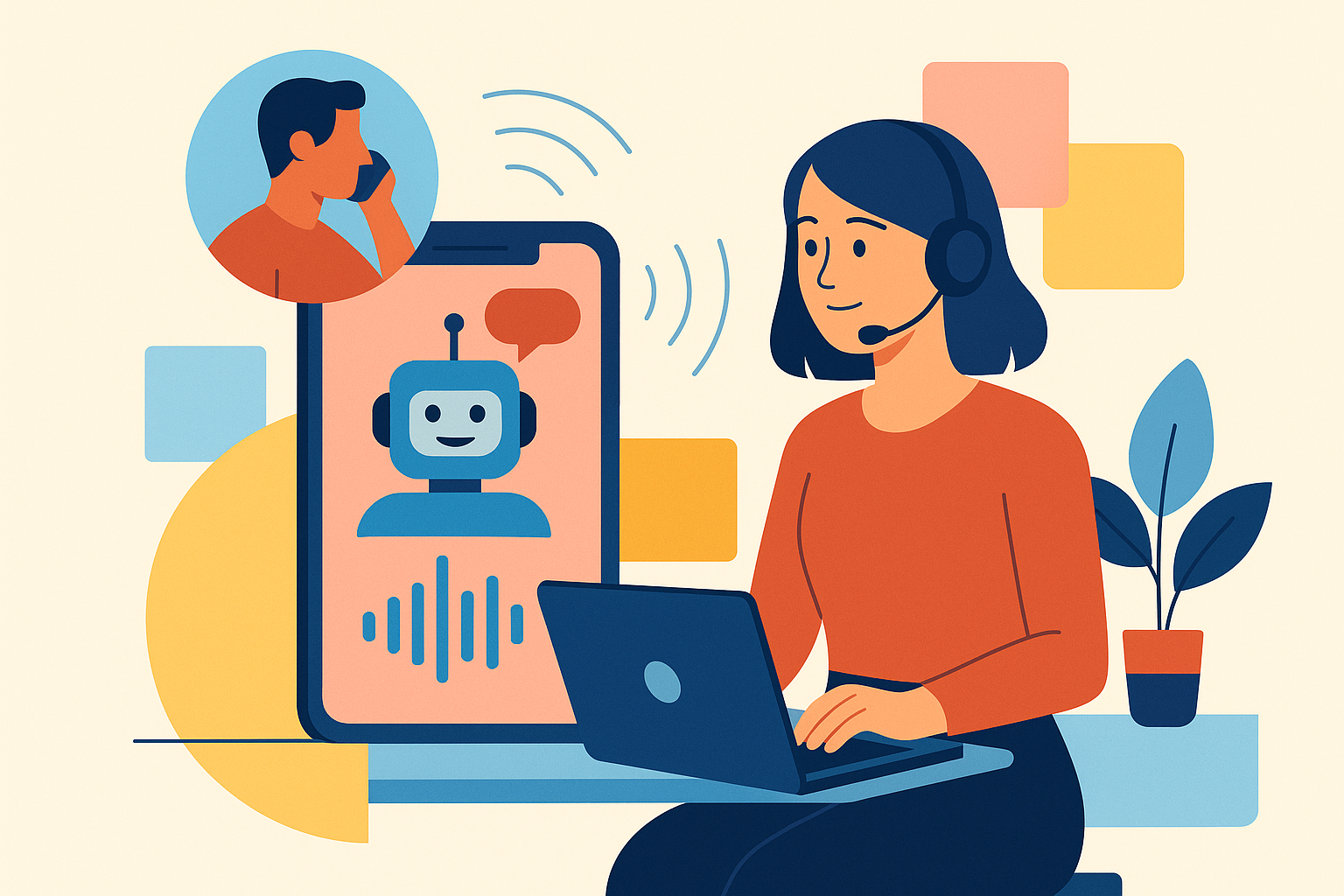
Why AI Voice Agents Are Transforming Customer Service in 2026
The AI voice agent market is experiencing explosive growth. Valued at $3.7 billion in 2023, it is projected to reach $103.6 billion by 2026, according to SuperAGI. This 2,700% growth reflects a fundamental shift: businesses are moving from rule-based IVR systems to intelligent, conversational AI that can understand context, adapt to customer needs, and handle complex workflows autonomously.
According to NextLevel.AI, one in ten customer service interactions will be fully automated by agentic voice AI by 2026. This trend is driven by measurable business outcomes:
- CSAT improvements of 5-20% with 24/7 AI support implementation (SuperAGI / Gartner)
- Cost reductions of up to 30% for round-the-clock availability (SuperAGI / Gartner)
- 91% customer satisfaction with AI in contact centers (ElectroIQ)
"AI voice agents represent the convergence of natural language understanding, real-time decision-making, and enterprise system integration—enabling businesses to scale customer service without proportional cost increases." — Keerok, AI automation experts
The Technology Stack Behind Modern Voice AI
A production-ready AI voice agent in 2026 typically combines:
- Speech-to-Text (STT): Google Cloud Speech-to-Text, AWS Transcribe, Deepgram (real-time transcription with <95ms latency)
- Natural Language Understanding (NLU): OpenAI GPT-4, Anthropic Claude, Google PaLM (intent recognition, entity extraction, context maintenance)
- Dialogue Management: Rasa, Botpress, or custom orchestration layers (conversation flow, state management, escalation logic)
- Text-to-Speech (TTS): ElevenLabs, Google Cloud TTS, AWS Polly (natural, expressive voice synthesis)
- Integration Layer: REST APIs, webhooks, CRM connectors (Salesforce, HubSpot, Zendesk)
The key differentiator in 2026 is agentic AI: systems that don't just respond to queries but autonomously execute multi-step workflows, make decisions based on business rules, and learn from every interaction.
Real-World Use Cases: How Businesses Deploy AI Voice Agents
AI voice automation is no longer theoretical. Here are production use cases across industries:
1. E-commerce: Order Management and Proactive Upselling
Major retailers like Amazon and Walmart use AI voice agents to:
- Handle order status inquiries ("Where is my package?")
- Process returns and refunds autonomously
- Provide personalized product recommendations during sales events
Technical implementation: Voice agent integrates with order management system (OMS) via API, retrieves real-time shipping data, and uses customer purchase history to suggest complementary products.
Results: 70% call deflection rate, 25% increase in upsell conversions, 40% reduction in average handle time (AHT).
2. Telecom: Proactive Alerts and Service Upgrades
A telecom provider deploys AI voice agents to:
- Alert customers approaching data limits
- Recommend personalized upgrade plans based on usage patterns
- Handle tier-1 technical support (password resets, account updates)
Technical implementation: Predictive analytics engine monitors real-time usage data, triggers outbound voice agent calls when thresholds are reached, and presents tailored offers based on customer segment and propensity models.
Results: 30% reduction in service interruptions, 20% increase in upgrade conversions, 15% improvement in Net Promoter Score (NPS).
3. Healthcare: Appointment Scheduling and Patient Triage
Medical practices and telehealth platforms use AI voice agents for:
- 24/7 appointment booking with real-time calendar integration
- Automated appointment reminders and rescheduling
- Symptom triage and routing to appropriate care level
Technical implementation: Voice agent connects to EHR (Epic, Cerner) via HL7/FHIR APIs, checks provider availability, books appointments, and sends confirmations via SMS/email. For triage, NLU extracts symptoms and applies clinical decision trees to recommend next steps.
Results: 60% reduction in administrative workload, 25% decrease in no-show rates, 99.5% uptime for after-hours scheduling.
4. Financial Services: Account Management and Fraud Detection
Banks and fintechs deploy AI voice agents to:
- Handle balance inquiries, transaction history, and account updates
- Verify customer identity using voice biometrics
- Detect and alert on suspicious transactions in real-time
Technical implementation: Voice agent integrates with core banking system, uses voice biometrics (Nuance, Pindrop) for authentication, and triggers fraud detection workflows when anomalies are detected.
Results: 80% call automation rate for routine inquiries, 50% reduction in fraud-related losses, 95% customer acceptance of voice biometric authentication.
"The most successful AI voice agent deployments share a common trait: tight integration with existing business systems, enabling real-time data access and action execution." — Keerok insight
Technical Implementation Guide: From Proof-of-Concept to Production
Deploying an AI voice agent at scale requires a systematic approach. Here's a technical roadmap:
Phase 1: Discovery and Use Case Definition (Weeks 1-2)
Objectives:
- Analyze call volume, peak hours, and common intents (use call center analytics)
- Identify high-volume, low-complexity use cases suitable for automation
- Define success metrics (FCR, AHT, CSAT, cost per call)
Deliverables:
- Call intent taxonomy (e.g., order status, appointment booking, billing inquiry)
- Prioritized use case roadmap
- ROI model and success criteria
Phase 2: Platform Selection and Architecture Design (Weeks 3-4)
Key decisions:
- Build vs. Buy: SaaS platforms (Dialpad AI, Talkdesk, Five9) for rapid deployment, or custom stack for maximum control?
- STT/TTS providers: Optimize for latency (<100ms), accuracy (>95% WER), and language support
- LLM selection: GPT-4 for complex reasoning, Claude for safety, or fine-tuned open-source models (Llama, Mistral) for cost optimization
- Integration strategy: API-first design, webhook-based event handling, or ETL pipelines for batch data sync
Sample architecture (custom stack):
[Phone System] → [SIP Gateway] → [STT Engine] → [NLU/LLM] → [Dialogue Manager] → [Integration Layer] → [CRM/ERP]
                                                ↓
                                          [TTS Engine] → [SIP Gateway] → [Phone System]
Deliverables:
- Technical architecture diagram
- Technology stack selection
- Integration requirements document
Phase 3: Conversation Design and Training Data Preparation (Weeks 5-6)
Best practices:
- Intent mapping: Define 10-20 core intents with 50-100 training examples each
- Entity extraction: Identify key data points (account number, order ID, appointment date) and train NER models
- Dialogue flows: Design multi-turn conversations with context retention, clarification strategies, and graceful fallback
- Tone and personality: Align voice agent persona with brand guidelines (formal, friendly, concise)
Example conversation flow (appointment booking):
Agent: Hi, this is [Company] AI assistant. How can I help you today?
User: I need to book an appointment.
Agent: Great! What type of appointment do you need? We offer consultations, follow-ups, and routine check-ups.
User: A consultation.
Agent: Perfect. I have availability on Tuesday the 15th at 2 PM or Thursday the 17th at 10 AM. Which works better for you?
User: Tuesday at 2.
Agent: Confirmed! You're booked for Tuesday, March 15th at 2 PM. You'll receive a confirmation text shortly. Anything else I can help with?
User: No, that's all.
Agent: Great! Have a wonderful day.
Deliverables:
- Intent taxonomy and training data
- Dialogue flow diagrams
- Voice agent script library
Phase 4: Integration and Testing (Weeks 7-10)
Integration tasks:
- Connect to CRM (Salesforce, HubSpot) for customer data retrieval
- Integrate with scheduling system (Calendly, Acuity, custom) for appointment booking
- Link to order management or ERP for real-time data access
- Set up webhooks for event-driven workflows (e.g., trigger email on appointment confirmation)
Testing strategy:
- Unit testing: Validate individual components (STT accuracy, NLU intent classification, TTS quality)
- Integration testing: End-to-end flow validation with mock data
- User acceptance testing (UAT): Internal team tests with real scenarios
- Pilot testing: Deploy to 5-10% of traffic, monitor KPIs, iterate
Key metrics to monitor:
- Intent recognition accuracy (target: >90%)
- Task completion rate (target: >80%)
- Escalation rate to human agent (target: <20%)
- Average call duration (benchmark against human agents)
- CSAT score (post-call survey)
Deliverables:
- Integrated voice agent system
- Test reports and bug fixes
- Pilot results and optimization recommendations
Phase 5: Production Deployment and Monitoring (Weeks 11-12)
Deployment checklist:
- Load testing: Ensure system handles peak call volumes (e.g., 1000 concurrent calls)
- Failover strategy: Configure human agent fallback for system outages
- Compliance: GDPR/CCPA compliance, call recording consent, data encryption
- Monitoring: Real-time dashboards (call volume, latency, error rates, CSAT)
Continuous optimization:
- Weekly review of escalated calls to identify new intents or edge cases
- A/B testing of dialogue variations to improve conversion rates
- Retraining NLU models with production data every 2-4 weeks
- Customer feedback loops to refine tone and response quality
At Keerok, we specialize in end-to-end AI voice agent deployment, from architecture design to production monitoring. Our team ensures seamless integration with your existing tech stack (CRM, ERP, custom databases) and provides ongoing optimization to maximize ROI.
Cost Analysis: AI Voice Agents vs. Human Teams
For a mid-sized business handling 10,000 calls/month, here's a 12-month cost comparison:
| Cost Component | Human Team (5 FTE) | AI Voice Agent |
|---|---|---|
| Salaries + Benefits | $300,000 (5 × $60k) | $0 |
| Training & Onboarding | $15,000 | $0 |
| Infrastructure (telephony, CRM) | $20,000 | $20,000 |
| AI Platform + API Costs | $0 | $36,000 ($3k/month) |
| Initial Development & Integration | $0 | $50,000 (one-time) |
| Total Year 1 | $335,000 | $106,000 |
| Total Year 2+ | $335,000/year | $56,000/year |
Annual savings: $229,000 (68%) in Year 1, $279,000 (83%) in subsequent years.
Beyond direct cost savings, AI voice agents deliver:
- 24/7 availability: No night shifts, weekends, or holidays
- Infinite scalability: Handle 10x call volume spikes without hiring
- Consistent quality: No variability in tone, accuracy, or adherence to scripts
- Data-driven insights: Every call transcribed, analyzed, and used for continuous improvement
"The ROI of AI voice agents isn't just cost reduction—it's the ability to scale customer service exponentially without linear cost growth." — Keerok analysis
Emerging Trends: Agentic AI and the Future of Voice Automation
The voice AI landscape is evolving rapidly. Key trends shaping 2026:
1. Agentic AI: Autonomous, Multi-Step Workflows
According to SuperAGI, 23% of organizations are already scaling agentic AI systems capable of automating complex, multi-step tasks, while 39% are actively experimenting. These agents don't just respond—they:
- Execute workflows across multiple systems (e.g., check inventory, create order, send confirmation email)
- Make autonomous decisions based on business rules and ML models
- Learn from outcomes and refine strategies over time
Example: A customer calls to return a product. The agentic voice agent verifies eligibility, generates a return label, schedules a pickup, processes the refund, and updates the CRM—all without human intervention.
2. Proactive Customer Engagement
Voice agents are shifting from reactive (answering calls) to proactive (initiating calls). Use cases include:
- Churn prevention: Identify at-risk customers and call with retention offers
- Upsell/cross-sell: Detect buying signals and proactively recommend products
- Service alerts: Notify customers of outages, delays, or account issues
Technical enabler: Predictive analytics engines (using customer behavior data, ML models) trigger outbound voice agent campaigns.
3. Multimodal AI: Voice + Vision + Text
Next-generation voice agents combine multiple modalities:
- Voice for natural conversation
- Screen sharing for visual troubleshooting
- SMS/email for follow-up documentation
Example: A technical support call where the voice agent talks the customer through a fix while simultaneously sharing a step-by-step guide on their phone.
4. Real-Time Sentiment Analysis and Adaptive Responses
Modern voice agents analyze tone, sentiment, and emotion in real-time, adapting their responses accordingly:
- Detect frustration → escalate to human agent or offer compensation
- Detect satisfaction → ask for review or referral
- Detect confusion → simplify language and provide additional context
Technology: Emotion AI platforms (Affectiva, Hume AI) integrated with voice agent stack.
5. Voice Agent Market Explosion
According to a16z, voice agent companies now represent 22% of the latest Y Combinator batch—a clear signal of massive investor and founder interest. This influx of innovation is driving:
- Rapid price decreases (API costs down 60% year-over-year)
- Improved model quality (near-human parity in most scenarios)
- Vertical-specific solutions (healthcare, finance, legal, real estate)
Common Pitfalls and How to Avoid Them
Based on hundreds of deployments, here are the most common failure modes:
- Over-automation too quickly: Start with 1-2 high-volume, low-complexity use cases. Prove ROI before expanding.
- Poor conversation design: Customers abandon calls if the agent doesn't understand or takes too long. Invest in UX research and iterative testing.
- Weak integration: A voice agent without real-time data access can't personalize or execute actions. Prioritize API integration from day one.
- No human fallback: Always provide an easy escalation path. Customers stuck in a loop will churn.
- Ignoring compliance: GDPR, CCPA, HIPAA, and industry-specific regulations must be baked into the system design, not bolted on later.
- Lack of continuous improvement: Voice agents degrade over time if not retrained. Schedule regular model updates and conversation flow refinements.
"The difference between a successful voice agent deployment and a failed one often comes down to change management—training your team, setting customer expectations, and iterating based on real-world feedback." — Keerok best practice
Conclusion: Your Roadmap to AI Voice Agent Success in 2026
AI voice agents are no longer experimental—they are production-ready, cost-effective, and delivering measurable business outcomes. With 91% customer satisfaction rates, 30% cost reductions, and a market growing to $103.6 billion, the question is not if but when to deploy.
Action steps for your organization:
- Audit your call center data: Identify high-volume, repetitive use cases
- Define clear success metrics: Cost savings, CSAT improvement, call deflection rate
- Choose your deployment model: SaaS for speed, custom for control
- Start with a pilot: 1-2 use cases, 5-10% of traffic, 4-6 weeks
- Measure, iterate, scale: Use pilot learnings to refine and expand
At Keerok, we build custom AI voice agents tailored to your business needs, integrated with your existing systems (CRM, ERP, databases), and optimized for your specific use cases. From initial strategy to production deployment and ongoing optimization, we partner with you to transform customer service through intelligent automation.
Get in touch with our team to discuss your AI voice agent project and schedule a personalized demo.