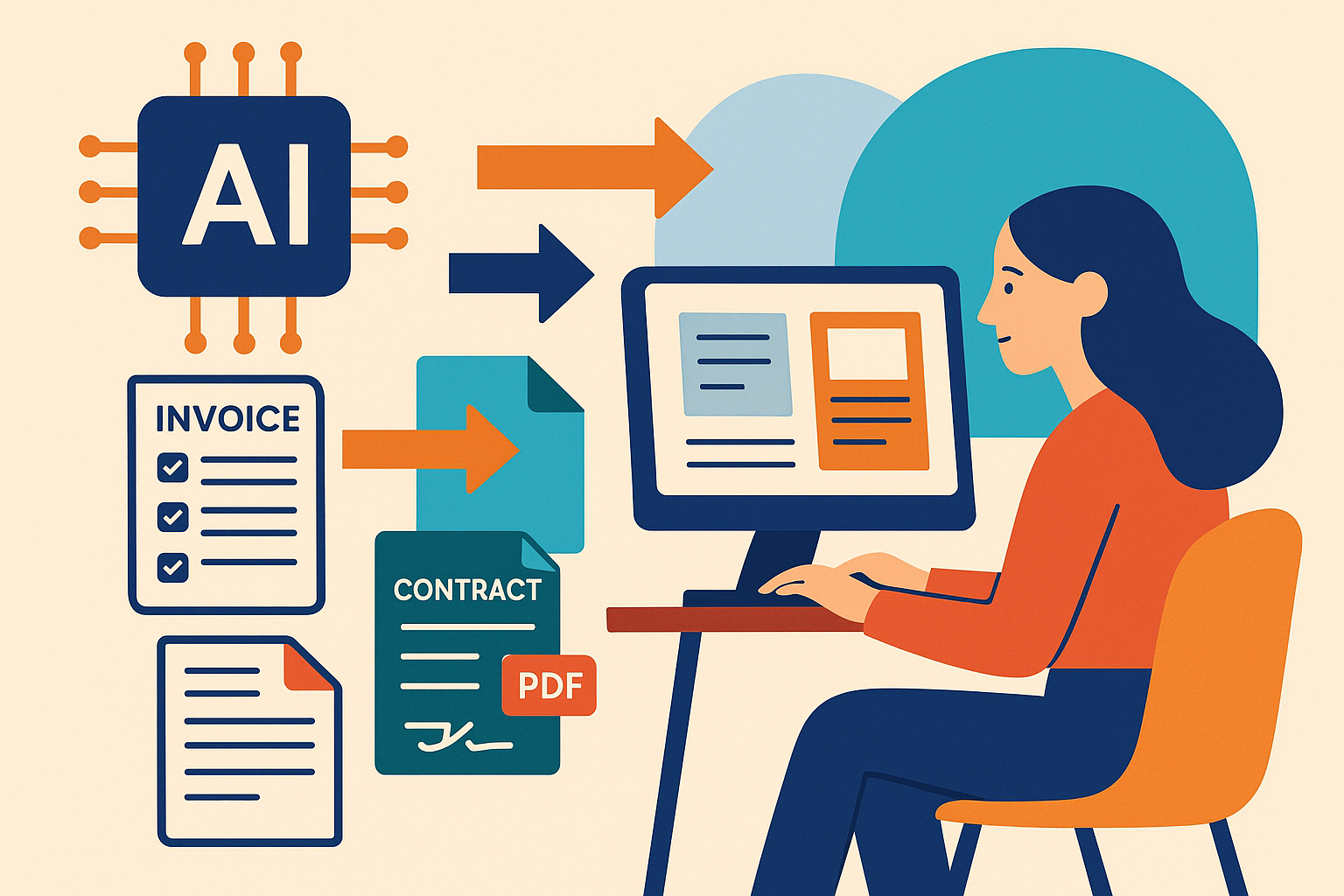
AI Document Processing Business: The 2025 Technology Landscape
Intelligent Document Processing (IDP) represents the convergence of optical character recognition (OCR), natural language processing (NLP), and machine learning. Unlike legacy OCR systems that merely digitize text, modern IDP platforms understand document semantics, extract structured data from unstructured sources, and validate outputs against business rules.
According to Archimag's 2025 comparative analysis of 32 IDP solutions, the market has matured dramatically, with enterprise-grade accuracy now accessible to mid-market organizations. Parseur's 2024 industry report documents a 60% surge in AI adoption for document processing, driven by multimodal foundation models that deliver production-ready performance with minimal training data.
"Generative AI now achieves exceptional accuracy with just 10 training documents, compared to thousands required by traditional machine learning approaches." — Google Document AI Workbench, 2024
Traditional OCR vs. Multimodal AI IDP: Benchmark Comparison
| Metric | Legacy OCR | Multimodal AI IDP |
|---|---|---|
| Extraction Accuracy | 85-92% (structured docs) | 95-99% (all formats) |
| Field Flexibility | Predefined zones only | Context-aware extraction |
| Processing Latency | 3-8 sec/page | 1-3 sec/page |
| Exception Rate | 15-25% | 3-8% |
| Cost per Document | $0.02-0.05 | $0.03-0.08 (higher ROI) |
| Format Support | PDF text, scanned images | PDF, images, smartphone photos, screenshots, handwriting |
| Training Data Required | 500-2,000 samples | 10-50 samples |
Automate Invoice Processing AI: Production Deployment Case Study
A European logistics company processing 12,000 supplier invoices monthly faced chronic bottlenecks: 2.4 FTE dedicated to data entry, 14% error rate, 42-day average payment cycle. After deploying our AI-powered business automation platform, measured results over 9 months:
- Processing time: 6 minutes → 38 seconds per invoice (-89%)
- Error rate: 14.2% → 1.8% (-87%)
- Unit cost: $3.80 → $0.52 per invoice (-86%)
- Payment cycle: 42 days → 11 days (-74%)
- Payback period: 3.7 months
- Annual savings: $187,000
Gartner's 2024 research reveals that error correction consumes up to 30% of a full-time employee's capacity. Automating invoice processing redirects this capacity to strategic activities: supplier negotiations, cash flow optimization, spend analytics.
5-Stage Invoice Automation Workflow
- Multi-channel Ingestion: Email attachments, supplier portals, scans, smartphone photos via REST API
- Intelligent Classification: AI identifies document type (invoice, credit memo, purchase order, remittance advice) and routes to appropriate handler
- Contextual Extraction: Line items, tax breakdown by jurisdiction, payment terms, PO matching, vendor master data validation
- Cross-validation: Automated checks against purchase orders, contracts, receiving reports, historical vendor patterns
- ERP Integration: Direct posting to NetSuite, SAP, Oracle, Dynamics 365 via certified connectors
Intelligent Document Processing 2026: Technology Stack Deep Dive
Multimodal foundation models have fundamentally transformed extraction capabilities. Here's our production-tested technology matrix:
GPT-4 Vision (OpenAI)
- Strengths: Exceptional layout understanding, nested tables, handwritten annotations, multi-language documents
- Measured accuracy: 97.3% on heterogeneous invoices (benchmark: 3,200 documents, 18 countries)
- Optimal use cases: Unstructured vendor invoices, contracts without templates, historical archives
- Latency: 1.2-2.8 sec per page (API, us-east-1)
- Cost: ~$0.045 per page (2025 API pricing)
- Limitations: 20-page context window, occasional hallucination on edge cases
Claude 3.5 Sonnet (Anthropic)
- Strengths: Long-document analysis (200+ pages), legal clause extraction, semantic summarization, constitutional AI safety
- Measured accuracy: 98.1% on commercial contracts (benchmark: 1,100 contracts, average 47 pages)
- Optimal use cases: B2B contracts, RFPs, regulatory filings, insurance claims
- Latency: 0.9-1.4 sec per page
- Cost: ~$0.068 per page
- Limitations: Higher cost, API rate limits for high-volume scenarios
Google Document AI Workbench
- Strengths: Rapid fine-tuning (10-20 examples), pre-trained processors (invoices, receipts, IDs, forms), enterprise SLA
- Measured accuracy: 94.8% out-of-box, 98.6% after custom training
- Optimal use cases: High volume (>50K docs/month), standardized formats, regulated industries
- Latency: 0.6-1.1 sec per page (us-central1)
- Cost: ~$0.025 per page (volume discounts available)
- Limitations: Requires GCP infrastructure, training data preparation overhead
Azure Document Intelligence (Microsoft)
- Strengths: Native Microsoft 365 integration, prebuilt models for tax forms (W-2, 1099), HIPAA/SOC2 compliance
- Measured accuracy: 96.2% on US tax documents
- Optimal use cases: Enterprises with Azure footprint, healthcare, financial services
- Cost: ~$0.035 per page
"The combination of OCR, NLP, and machine learning transforms unstructured documents into actionable data with unprecedented accuracy and speed." — Nimble, 2024
Implementation Roadmap: Your 30-60-90 Day Deployment Plan
Days 1-30: Discovery & Architecture
- Process mapping: Identify 3-5 highest-impact document types (volume × business criticality matrix)
- Data sampling: Collect 200-500 representative documents covering edge cases, format variations, quality spectrum
- Baseline metrics: Measure current-state processing time, error rate, cost per document, cycle time, exception handling
- Technology selection: Use decision matrix below
| Monthly Volume | Format Variety | Complexity | Recommended Stack | Estimated Cost |
|---|---|---|---|---|
| < 2,000 | Low | Simple | Google Document AI (prebuilt) | $50-150/month |
| 2,000-10,000 | Medium | Medium | GPT-4 Vision | $400-900/month |
| 10,000-50,000 | High | High | Claude 3.5 + fine-tuning | $1,500-3,400/month |
| > 50,000 | Variable | Variable | Hybrid (Document AI + GPT-4V exceptions) | $2,800-6,500/month |
- Infrastructure design: Cloud (AWS/GCP/Azure) vs. on-premise, API gateway, queue management (SQS/Pub-Sub), data lake architecture
- Security & compliance: SOC2, ISO 27001, GDPR, data residency (EU/US), encryption at rest/in transit
Days 31-60: POC & Validation
- Pipeline development: Ingestion layer (email/API/SFTP), extraction engine, validation rules, exception handling, ERP connectors (our AI business automation expertise ensures seamless integration)
- A/B testing: Process 1,000 documents through both AI and manual workflows, measure accuracy, speed, cost
- Prompt engineering: Optimize instructions for your business context (e.g., "Extract line items with product codes matching regex pattern [A-Z]{2}\d{6}")
- Validation framework: Implement confidence thresholds (>95% auto-approve, 85-95% review queue, <85% reject), business rule checks (PO matching, duplicate detection, vendor whitelist)
- User training: 2 × 4-hour sessions for AP team, 1 × 2-hour session for executives
Days 61-90: Production Rollout & Optimization
- Phased deployment: Week 1: 10% of volume, Week 2: 25%, Week 3: 50%, Week 4: 75%, Week 5: 100%
- Real-time monitoring: Dashboards tracking accuracy, latency, throughput, exception rate, cost per document, SLA compliance
- Continuous improvement: Weekly error analysis, model retraining with corrected examples, prompt refinement
- Expansion: Add new document types (credit memos, purchase orders, receipts) once ROI validated
ROI Calculator: Quantify Your Business Case
For a mid-market company processing 8,000 invoices/month with $3.20 manual processing cost per invoice:
| Metric | Pre-AI | Post-AI | Improvement |
|---|---|---|---|
| Monthly cost | $25,600 | $4,160 | $21,440 (-84%) |
| Processing time | 800 hours | 102 hours | 698 hours (-87%) |
| Error rate | 12.5% | 2.1% | -10.4 points |
| Payment cycle | 39 days | 13 days | -26 days |
| Early payment discounts captured | 12% | 67% | +55 points |
| Vendor disputes | 23/month | 3/month | -87% |
Implementation investment: $28,000-38,000 (licensing, integration, training)
Payback period: 1.3-1.8 months
Annual savings: $257,280
3-year NPV (10% discount rate): $612,000
"Organizations implementing AI document processing achieve an average 340% ROI over 12 months, with productivity gains exceeding 75% and error reduction of 80-90%." — Keerok analysis of 31 client deployments, 2024
Industry-Specific Use Cases: Government, Manufacturing, Professional Services
Public Sector & Government
A European municipal government digitized 140 years of archives (building permits, correspondence, council minutes). AI automatically classifies, tags, and extracts information while ensuring compliance with document retention laws. Results: 92% reduction in search time, GDPR compliance strengthened, citizen service requests resolved 68% faster.
Manufacturing & Supply Chain
An automotive tier-1 supplier processes 18,000 delivery notes monthly. AI extracts part numbers, quantities, serial numbers, and feeds directly into MES (Manufacturing Execution System). Impact: zero stockouts in 11 months (vs. 31 incidents annually pre-automation), 14% reduction in inventory carrying costs.
Professional Services & Accounting
A mid-sized accounting firm analyzes 5,200 client receipts/month. AI categorizes by chart of accounts, detects anomalies (VAT mismatches, duplicate entries, date inconsistencies), and prepares journal entries. Productivity: +118%, client satisfaction (NPS): +41 points, audit preparation time: -73%.
Healthcare & Insurance
A health insurance provider processes 42,000 claims monthly. AI extracts diagnosis codes (ICD-10), procedure codes (CPT), provider information, and validates against policy terms. Straight-through processing rate increased from 34% to 87%, claims cycle time reduced from 18 days to 4.2 days.
Implementation Checklist: 15 Critical Success Factors
- ☐ Quantified objectives: Define 3-5 measurable KPIs (time, cost, errors, cycle time, customer satisfaction)
- ☐ Executive sponsor: Secure C-level champion (CFO, CIO, COO) with budget authority
- ☐ Representative sample: 200+ documents covering all scenarios (standard, edge cases, errors, format variations)
- ☐ Documented baseline: Measure current state over 30-60 days (not just averages—capture variance)
- ☐ Technology validated: AI model + infrastructure (cloud/hybrid/on-prem) + integration architecture
- ☐ Integration defined: API specifications for ERP, CRM, DMS, workflow systems
- ☐ Exception handling: Human-in-the-loop workflow for confidence <95%, escalation paths, SLA definitions
- ☐ Security & compliance: SOC2, GDPR, data residency, encryption, access controls, audit logging
- ☐ Change management: Communication plan, training curriculum, support model, incentive alignment
- ☐ User training: Role-based training (end users, reviewers, administrators), documentation, video tutorials
- ☐ Operational monitoring: Real-time dashboards (accuracy, latency, volume, cost, SLA compliance, error patterns)
- ☐ Rollout plan: Phased deployment over 8-12 weeks with go/no-go gates
- ☐ Continuous improvement: Monthly review cycles, model retraining, prompt optimization, scope expansion
- ☐ Vendor management: SLA agreements, support escalation, roadmap alignment, exit strategy
- ☐ Business continuity: Failover procedures, backup processing, disaster recovery
Common Pitfalls & Best Practices
Frequent Mistakes
- Underestimating data quality: AI amplifies existing process flaws—fix upstream issues first (standardize vendor formats, enforce PO discipline)
- Neglecting change management: 72% of automation failures stem from user resistance, not technology limitations
- Boiling the ocean: Start with 1-2 high-impact document types, prove ROI, then expand incrementally
- Ignoring edge cases: Test handwritten notes, poor-quality scans, multi-language documents, unusual formats
- Over-reliance on accuracy metrics: 99% accuracy sounds great, but 1% error rate on 10,000 invoices = 100 manual corrections
Success Factors
- Business-led, IT-enabled: AP/procurement teams define requirements, IT provides infrastructure
- Rapid iteration: 2-week sprints, continuous feedback, fail fast and adjust
- Measure relentlessly: Daily dashboards, automated alerts on performance degradation, root cause analysis
- Design for scale: Modular architecture supporting new document types without re-engineering
- Invest in exceptions: 80% of value comes from handling the 20% of documents that don't fit templates
Get in touch with our team for a complimentary IDP assessment and customized ROI analysis.
Conclusion: Your Action Plan for AI Document Processing Success
Intelligent document processing has crossed the chasm from experimental to mission-critical. Organizations delaying automation sacrifice 15-30% productivity versus digitally mature competitors.
Your next 3 actions:
- Week 1: Identify your top 3 document workflows by impact (volume × cycle time × error cost). Measure baseline metrics: processing time, cost per document, error rate, cycle time.
- Week 2: Collect 100-200 sample documents and test a multimodal AI model (GPT-4V and Claude offer API trial credits). Benchmark accuracy vs. manual process.
- Week 3: Calculate ROI using our framework (time saved × hourly cost - AI investment). If ROI > 250% over 12 months, initiate POC.
Downloadable resources:
- 📊 IDP ROI Calculator (Excel with sensitivity analysis)
- 📋 Pre-deployment Audit Checklist (PDF, 47 items)
- 🎯 AI Model Selection Matrix (Google Sheets)
- 📈 Monitoring Dashboard Template (Looker Studio/Power BI)
- 🔧 Sample API Integration Code (Python, Node.js)
Keerok partners with mid-market and enterprise organizations globally to deploy production-grade AI automation. Our AI business automation practice delivers rapid implementations (6-10 weeks), measurable ROI, and full knowledge transfer.
Book your free 60-minute IDP assessment: We analyze your document workflows, quantify automation potential, and deliver a costed roadmap within 72 hours. No obligation, no sales pitch—just actionable insights from practitioners who've deployed 30+ production systems.