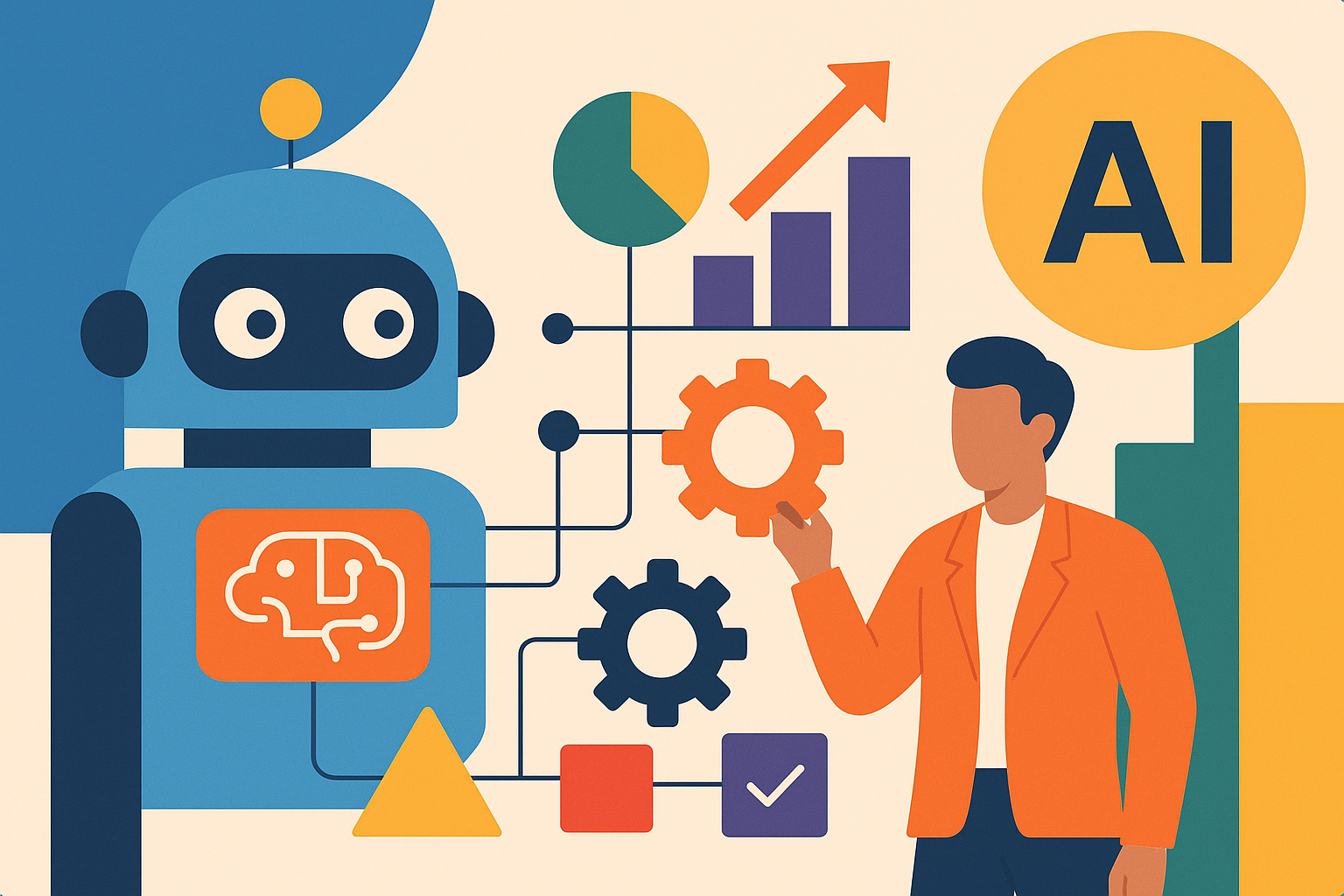
Understanding Autonomous AI Agents: Beyond Chatbots
An autonomous AI agent represents a fundamental shift from reactive AI tools to proactive, decision-making systems. Unlike traditional chatbots that follow scripted responses, AI agents can perceive their environment, reason about complex situations, plan multi-step actions, and execute tasks independently to achieve defined goals.
According to OpenAI's State of Enterprise AI report, weekly message volume in ChatGPT Enterprise multiplied by eight in one year, with average employees sending 30% more messages. This explosive growth signals a shift from experimentation to production-grade deployment. Citizen Call reports that AI agents now handle up to 80% of customer interactions, with 51% of consumers preferring to interact with these intelligent assistants.
Key insight: "The transition from AI experimentation to scaling is defined by a focus on measurable ROI rather than theoretical potential. Organizations are demanding concrete results: resolution rates, efficiency gains, and customer satisfaction improvements." - IBM 2025 Analysis
Core capabilities that define effective AI agents
- Autonomous decision-making: Ability to analyze situations and select appropriate actions without constant human intervention
- Contextual awareness: Access to proprietary company data and understanding of existing workflows through integrations
- Multi-step planning: Breaking down complex goals into actionable subtasks and executing them sequentially
- Continuous learning: Performance improvement based on interactions, feedback, and outcome analysis
- Tool utilization: Ability to call APIs, query databases, send emails, and interact with external systems
The architectural difference is fundamental: traditional AI systems are reactive (respond to inputs), while AI agents are proactive (pursue goals autonomously). This distinction enables entirely new categories of business automation.
7 Production-Ready AI Agent Use Cases
1. Intelligent customer service and technical support
Publishing and information services company Wiley deployed AI agents for customer interaction management, achieving a 40% increase in resolved cases according to Salesforce (October 2024). Modern customer service agents can:
- Handle tier-1 support queries 24/7 across multiple languages
- Automatically escalate complex cases to human agents with full context
- Perform sentiment analysis to prioritize urgent or frustrated customers
- Generate real-time satisfaction reports and identify improvement opportunities
- Proactively reach out to customers based on behavioral triggers (e.g., abandoned carts, feature struggles)
Technical implementation: Integrate an AI agent with your existing CRM (Salesforce, HubSpot, Zendesk) via API. Configure conditional workflows based on natural language understanding (NLU) to route requests by complexity, urgency, and required expertise. Implement a hybrid model where the agent handles routine queries while seamlessly transferring complex issues to human agents with complete conversation history.
Code example (Python with LangChain):
from langchain.agents import initialize_agent, Tool
from langchain.chat_models import ChatOpenAI
from langchain.memory import ConversationBufferMemory

# Define tools the agent can use
tools = [
    Tool(
        name="KnowledgeBase",
        func=search_knowledge_base,
        description="Search company documentation and FAQs"
    ),
    Tool(
        name="TicketSystem",
        func=create_support_ticket,
        description="Create a support ticket for human follow-up"
    ),
    Tool(
        name="CustomerData",
        func=get_customer_info,
        description="Retrieve customer account information and history"
    )
]

# Initialize agent with memory
memory = ConversationBufferMemory(memory_key="chat_history")
agent = initialize_agent(
    tools=tools,
    llm=ChatOpenAI(model="gpt-4", temperature=0),
    agent="conversational-react-description",
    memory=memory,
    verbose=True
)

# Agent autonomously decides which tools to use
response = agent.run("Customer asks: Why was I charged twice?")
2. Financial automation and fraud detection
A Workday 2025 study reveals that 73% of employees believe AI agents can help fill talent gaps in finance, with 38% identifying fraud detection as a priority use case. Financial AI agents can:
- Automate budget forecasting with predictive analytics based on historical data and market trends
- Detect transaction anomalies in real-time using pattern recognition and statistical analysis
- Generate compliance-ready financial reports automatically
- Optimize cash flow with actionable recommendations on payment timing and investment allocation
- Reconcile accounts by matching transactions across multiple systems
Implementation architecture: Connect an AI agent to your ERP system (SAP, Oracle, NetSuite) via secure API. The agent continuously monitors transactions, compares them against historical patterns and predefined rules, and triggers alerts when anomalies exceed threshold levels. For detected fraud attempts, the agent automatically generates a preliminary investigation report and notifies the finance team.
Technical stack: Combine a reasoning LLM (GPT-4, Claude 3) with specialized ML models for anomaly detection. Use time-series analysis for forecasting and graph neural networks for transaction network analysis to identify suspicious patterns.
3. Automated HR and talent management
According to Workday, 75% of employees are ready to collaborate with AI agents, though only 25% would accept being managed by one. This distinction is crucial: AI agents should augment HR professionals, not replace them. HR agents can:
- Pre-screen candidates by analyzing resumes against job requirements using semantic matching
- Automatically schedule interviews by synchronizing calendars and sending personalized invitations
- Answer employee questions about HR policies, benefits, and procedures 24/7
- Process routine requests (time off, expense reports, document requests) with approval workflows
- Identify retention risks by analyzing engagement data and exit interview patterns
Configuration best practices: Deploy a conversational agent on Slack or Microsoft Teams with secure access to HR databases. Implement strict privacy controls (GDPR compliance) and require human approval for sensitive decisions. Use role-based access control to ensure employees only access their own data unless authorized.
4. Sales lead generation and qualification
AI sales agents transform prospecting by analyzing thousands of signals to identify and engage the most promising leads. They can:
- Automatically enrich prospect data from LinkedIn, company databases, and public sources
- Score leads based on conversion probability using predictive models
- Personalize outreach emails at scale while maintaining authenticity
- Schedule follow-ups at optimal times based on engagement patterns
- Identify cross-sell and upsell opportunities within existing customer base
Technical stack: Combine an AI agent (Claude, GPT-4) with tools like Apollo.io for data enrichment, Lemlist for email automation, and your CRM. The agent orchestrates the complete workflow from lead detection to first meaningful interaction, continuously learning which approaches yield the highest response rates.
Workflow example:
- Agent monitors trigger events (job changes, funding rounds, technology adoptions)
- Enriches lead data and calculates fit score based on ICP (Ideal Customer Profile)
- Generates personalized outreach message referencing specific triggers
- Sends email and tracks engagement (opens, clicks, replies)
- Schedules follow-up based on engagement level and optimal timing
- Escalates hot leads to sales team with complete context and talking points
5. Intelligent supply chain management
For manufacturing and e-commerce businesses, AI agents optimize supply chains in real-time:
- Demand forecasting based on historical data, seasonal trends, and external factors (weather, events)
- Automated inventory optimization to minimize holding costs while preventing stockouts
- Supplier negotiation automation within predefined rules and approval thresholds
- Proactive alerts on supply chain risks (supplier delays, quality issues, geopolitical events)
- Route optimization for logistics considering costs, delivery times, and carbon footprint
Implementation approach: Integrate the AI agent with your inventory management system, ERP, and supplier portals. Use machine learning models for demand prediction and reinforcement learning for dynamic inventory optimization. The agent continuously monitors multiple data sources and adjusts orders, routes, and inventory levels autonomously within defined parameters.
6. Automated analytics and reporting
AI agents transform raw data into actionable insights without manual intervention:
- Generate customized dashboards for each department automatically
- Perform predictive analytics on KPIs with alerts on significant deviations
- Create executive summaries in natural language explaining trends and anomalies
- Provide strategic recommendations based on data patterns
- Conduct ad-hoc analysis in response to natural language queries
Technical implementation: Connect an AI agent to your data sources (Google Analytics, SQL databases, CRM, financial systems) via API connectors or data warehouses (Snowflake, BigQuery). Configure scheduled analyses and intelligent alerts that only notify stakeholders of statistically significant anomalies, reducing alert fatigue.
Example query handling: A CFO asks: "Why did customer acquisition cost increase 15% last quarter?" The agent autonomously queries marketing spend data, analyzes campaign performance, examines conversion funnels, identifies the primary drivers (e.g., increased competition in paid search), and generates a comprehensive report with visualizations and recommendations.
7. Content marketing automation
With OpenAI reporting that employees send 30% more messages on ChatGPT Enterprise, AI agents are becoming essential for content production:
- Generate SEO-optimized blog articles based on keyword research and competitor analysis
- Create platform-specific social media posts adapted to each channel's best practices
- Personalize newsletters for different customer segments
- Conduct automated A/B testing of headlines, CTAs, and content variations
- Repurpose long-form content into multiple formats (social posts, email sequences, infographics)
Workflow architecture: An AI agent analyzes your top-performing content, identifies trending topics in your industry using news APIs and social listening tools, generates content drafts, optimizes them for SEO (keyword density, readability, internal linking), and schedules publication at optimal engagement times. Human editors review and approve before publication, maintaining quality control.
Technical guide: Building your first AI agent in 5 steps
Step 1: Define scope and objectives
Before any technical implementation, precisely identify:
- The process to automate: Choose a repetitive workflow with clear rules (e.g., lead qualification, standard request processing)
- Success metrics: Define measurable KPIs (time saved, resolution rate, customer satisfaction, cost per interaction)
- Constraints: Budget, available technical skills, security requirements, compliance obligations
- Stakeholders: Who will use the agent, who will supervise it, who approves decisions
Expert recommendation: "Start with a simple use case with rapid ROI to demonstrate value before deploying more complex agents. Building organizational trust in AI is as important as the technology itself." - Keerok AI Automation
Step 2: Choose platform and architecture
Three main approaches exist for creating AI agents:
| Approach | Advantages | Disadvantages | Best for |
|---|---|---|---|
| No-code (Make, Zapier, n8n) | Rapid deployment, no development required | Limited customization, vendor lock-in | Simple workflows, non-technical teams |
| Low-code (LangChain, AutoGen) | Balance of flexibility and speed | Python/JS skills required | Conversational agents, RAG applications |
| Custom development | Full control, maximum optimization | High time and cost investment | Mission-critical agents, complex integrations |
Recommendation: Start with no-code platforms to validate the concept and demonstrate ROI, then evolve to low-code or custom development as requirements become more sophisticated. This staged approach minimizes risk and accelerates time-to-value.
Step 3: Integrate data and business knowledge
A high-performing AI agent requires contextual access to your proprietary data:
- Connect data sources: CRM, ERP, document repositories, emails (via secure APIs)
- Build a knowledge base: Document your processes, FAQs, internal policies in a structured format
- Implement RAG (Retrieval-Augmented Generation): Enable the agent to search your documents before responding
- Vectorize data: Use embeddings (OpenAI, Cohere, open-source models) for efficient semantic search
Advanced code example (Python with LangChain and Pinecone):
from langchain.embeddings import OpenAIEmbeddings
from langchain.vectorstores import Pinecone
from langchain.text_splitter import RecursiveCharacterTextSplitter
from langchain.document_loaders import DirectoryLoader
from langchain.chains import RetrievalQA
from langchain.chat_models import ChatOpenAI

# Load and process company documents
loader = DirectoryLoader('./company_docs', glob="**/*.pdf")
documents = loader.load()

# Split documents into chunks
text_splitter = RecursiveCharacterTextSplitter(
    chunk_size=1000,
    chunk_overlap=200
)
texts = text_splitter.split_documents(documents)

# Create vector store
embeddings = OpenAIEmbeddings()
vectorstore = Pinecone.from_documents(
    documents=texts,
    embeddings=embeddings,
    index_name="company-knowledge-base"
)

# Configure agent with knowledge access
llm = ChatOpenAI(model="gpt-4", temperature=0)
qa_chain = RetrievalQA.from_chain_type(
    llm=llm,
    chain_type="stuff",
    retriever=vectorstore.as_retriever(
        search_type="similarity",
        search_kwargs={"k": 3}
    ),
    return_source_documents=True
)

# Query with source citation
result = qa_chain({"query": "What is our refund policy?"})
print(f"Answer: {result['result']}")
print(f"Sources: {[doc.metadata['source'] for doc in result['source_documents']]}")
Step 4: Configure workflows and decision rules
Precisely define how the agent should react in different situations:
- Decision trees: Create flowcharts for common scenarios (if-then-else logic)
- System prompts: Write clear instructions defining the agent's role, tone, and limitations
- Human escalation: Define conditions triggering human intervention (confidence score < 70%, sensitive requests)
- Feedback loops: Implement mechanisms to capture user feedback and improve the agent
System prompt template:
You are an AI agent assisting customers of [Your Company].

Role: Answer questions about [products/services], process [request types], escalate complex cases.

Tone: Professional, helpful, concise. Use formal language.

Rules:
- If the request concerns [sensitive topic], transfer to a human agent
- Always cite sources when referencing the knowledge base
- If confidence < 70%, offer to transfer to an expert
- Collect [specific information] before processing the request
- Never make promises about [restricted actions]

Knowledge base: [context injected via RAG]

Available tools:
1. search_knowledge_base(query) - Search company documentation
2. create_ticket(description, priority) - Create support ticket
3. get_customer_info(customer_id) - Retrieve customer data
4. send_email(to, subject, body) - Send email

Think step-by-step before taking action.
Step 5: Test, deploy, and optimize
Deploying an AI agent is an iterative process:
- Internal testing phase: Have your team test the agent with real scenarios for 2-4 weeks
- Progressive rollout: Start with 10-20% of traffic to identify edge cases
- Continuous monitoring: Track key metrics (resolution rate, satisfaction, escalations) with real-time dashboards
- Iterative optimization: Analyze problematic conversations, enrich the knowledge base, refine prompts
- Scale gradually: Increase traffic percentage as performance stabilizes
Deployment checklist:
- ✅ Load testing completed (capacity to handle 100+ simultaneous requests)
- ✅ Failover plan for API outages (fallback to human agents)
- ✅ Compliance validated (GDPR, data retention, right to be forgotten)
- ✅ User documentation created
- ✅ Team training completed for agent supervision
- ✅ Escalation process tested and functional
- ✅ Monitoring and alerting configured
- ✅ Feedback collection mechanism implemented
Technologies and tools for building AI agents
LLMs and foundation models
The choice of language model directly impacts your agent's capabilities:
| Model | Strengths | Cost (approx.) | Ideal use case |
|---|---|---|---|
| GPT-4 (OpenAI) | Complex reasoning, multimodal, function calling | $$$ | Sophisticated conversational agents |
| Claude 3 (Anthropic) | Long context (200k tokens), safety, analysis | $$ | Document analysis, customer support |
| Gemini Pro (Google) | Multimodal, integration with Google ecosystem | $$ | Agents requiring vision capabilities |
| Llama 3 (Meta) | Open source, on-premise deployment | $ (infrastructure) | Ultra-sensitive data, full control |
| Mistral Large | European, multilingual, cost-effective | $$ | European companies, budget-conscious |
For businesses with data sovereignty concerns, open-source models like Llama 3 or European alternatives like Mistral AI offer credible alternatives to US-based solutions, with comparable performance and local hosting options.
Agent frameworks and development platforms
- LangChain / LangGraph: Python/JS framework for creating agents with memory, tools, and complex workflows. Most popular option with extensive documentation.
- AutoGen (Microsoft): Multi-agent conversational system where agents collaborate to solve problems. Excellent for complex reasoning tasks.
- CrewAI: Orchestration of specialized agent teams with defined roles and objectives. Role-based approach simplifies complex workflows.
- Semantic Kernel (Microsoft): SDK for integrating AI into .NET and Python applications. Strong enterprise focus.
- LlamaIndex: Specialized in data ingestion and RAG applications. Best for knowledge-intensive agents.
No-code and low-code tools
For companies without dedicated development teams:
- Make.com: Visual automation with AI connectors (GPT, Claude) and 1000+ integrations. Excellent for workflow automation.
- Zapier Central: No-code AI agent creation with conditional workflows. User-friendly interface.
- n8n: Open-source, self-hostable alternative for greater control. Technical but powerful.
- Voiceflow: Conversational agent creation with drag-and-drop interface. Strong for customer-facing chatbots.
- Relevance AI: No-code platform specifically designed for building AI agent workflows.
Keerok leverages these technologies to deploy AI agents adapted to each client's budget and technical capabilities, ensuring successful implementation regardless of internal resources.
Challenges and best practices for AI agent success
Managing hallucinations and ensuring reliability
LLMs can generate incorrect information with apparent confidence. To minimize this risk:
- Implement RAG systematically: Force the agent to cite sources from your knowledge base
- Use confidence scores: Configure human escalation thresholds when certainty is low
- Validate critical outputs: Require human approval for financial or legal decisions
- Test with adversarial prompts: Deliberately try to trick the agent to identify vulnerabilities
- Implement output validation: Use structured outputs and schema validation to ensure consistency
Core principle: "A reliable AI agent isn't one that never makes mistakes, but one that recognizes its limitations and requests help when necessary. Designing for graceful degradation is more important than pursuing perfect accuracy."
Ensuring GDPR compliance and security
For businesses handling personal data, protection is paramount:
- Data minimization: Only transmit information strictly necessary to LLMs
- Anonymization: Mask personal data before AI processing when possible
- European hosting: Prefer GDPR-compliant solutions (Mistral, Azure Europe, AWS Frankfurt)
- Traceability: Log all interactions for audits and data subject access requests
- Explicit consent: Clearly inform users they're interacting with AI
- Data retention policies: Automatically delete conversation logs after defined periods
Example disclaimer: "You're chatting with an AI assistant. Your messages are analyzed to improve service quality. Avoid sharing sensitive personal information. A human agent can take over at any time. By continuing, you consent to AI-assisted support as described in our privacy policy."
Change management and team training
According to Workday, 75% of employees accept collaborating with AI, but this adoption requires support:
- Transparent communication: Explain that AI agents augment human capabilities rather than replace jobs
- Hands-on training: Organize practical workshops so each team masters their AI agent
- Co-creation: Involve end-users in workflow design to build ownership
- Celebrate quick wins: Share early successes to create enthusiasm
- Address concerns directly: Create forums for employees to voice worries and ask questions
The most successful AI projects are those where business teams are involved from design, creating a sense of ownership rather than experiencing technology imposed from above.
Measuring ROI and continuous optimization
Define clear metrics from the start:
| Metric | How to measure | Typical target |
|---|---|---|
| Autonomous resolution rate | % of requests handled without human escalation | 70-85% |
| Average handling time | Duration from request to resolution | -50% vs manual process |
| User satisfaction | CSAT or NPS score post-interaction | > 4/5 or > 50 NPS |
| Cost per interaction | AI costs + supervision / number of interactions | -60% vs human support |
| Team productivity | Time freed for high-value tasks | +30% capacity |
| Error rate | % of incorrect responses requiring correction | < 5% |
Schedule monthly reviews to analyze these metrics and identify optimization opportunities. AI agents improve over time, but only if you invest in this continuous improvement loop.
The future of AI agents in business: 2025-2026 trends
The rise of agent orchestrators
According to IBM, agent orchestrators are becoming the backbone of enterprise AI systems by connecting multiple specialized agents. Rather than monolithic agents, companies deploy agent teams:
- A coordinator agent that analyzes requests and routes to the right specialist
- Expert agents by domain (finance, HR, logistics, sales)
- Validation agents that verify output quality
- Memory agents that maintain context across interactions
This multi-agent architecture enables deep specialization while maintaining a unified user experience. The coordinator acts as an intelligent router, selecting the best agent for each task and combining outputs when necessary.
AI agents and edge computing
AI models are becoming compact enough to run locally on devices (smartphones, IoT), opening new use cases:
- Offline AI assistants for field technicians
- Quality control agents embedded in industrial equipment
- Privacy-respecting voice assistants (no cloud transmission)
- Real-time translation agents on mobile devices
This trend addresses latency, privacy, and connectivity concerns, enabling AI agents in environments where cloud connectivity is unreliable or undesirable.
Native integration in business software
SaaS vendors are massively integrating native AI agents: Salesforce with Einstein, Microsoft with Copilot, SAP with Joule, ServiceNow with Now Assist. For businesses, this means:
- Less custom development required
- Pre-configured agents for standard workflows
- But increased vendor lock-in risk
The winning strategy combines proprietary agents (for differentiating processes) and SaaS agents (for standardized functions), creating a hybrid architecture that balances control and convenience.
Regulation and the European AI Act
The EU AI Act is being progressively enforced, imposing obligations based on AI system risk levels. For business AI agents:
- Mandatory transparency: Users must know they're interacting with AI
- Explainability: Ability to explain how the agent made a decision
- Human oversight: Supervision required for high-risk systems (HR, credit)
- Documentation: Complete traceability of development and deployment
- Conformity assessments: Third-party audits for high-risk applications
Companies that anticipate these requirements transform regulatory constraints into competitive advantages by building ethical and transparent AI agents from the start. This proactive approach avoids costly retrofitting and builds customer trust.
Conclusion: Take action with AI agents
AI agents are no longer futuristic technology reserved for tech giants. With 85% enterprise adoption in 2025 and measurable results (40% resolution increase at Wiley, 80% of customer interactions automated), they represent an essential competitive lever for businesses of all sizes.
Your concrete next steps:
- Identify your first use case: Choose a repetitive process with rapid ROI (customer service, lead qualification, reporting)
- Assess your resources: Available technical skills, budget, existing data
- Select your approach: No-code to start quickly, low-code for more flexibility
- Start small and iterate: A simple agent that works beats a complex system that fails
- Measure and optimize: Define clear KPIs and continuously improve
Final insight: "Success with AI agents doesn't depend on technological sophistication, but on alignment between the AI solution and real business needs. Start by solving a concrete problem, measure the impact, then scale. The organizations winning with AI are those treating it as a business transformation, not just a technology deployment."
Whether you're a startup looking to automate customer support or an enterprise optimizing supply chains, AI agents offer concrete, measurable solutions. The technology is mature, the frameworks are proven, and the ROI is demonstrable.
Ready to deploy your first AI agent? Get in touch with our team for a free audit of your automatable processes and a personalized roadmap. The AI transformation starts today, not tomorrow. Explore our AI agent expertise to see how we've helped businesses across industries implement autonomous workflows that deliver real business value.